
How to Learn Guitar Online: A Free Practice Roadmap
A complete, free roadmap to learn guitar online without paid courses: step-by-step learning stages, practice routines, interactive tools, and common mistakes.
You can learn guitar online completely free using structured practice routines, browser-based reference tools, and open educational resources without paying for a course subscription. Consistent daily practice of fifteen to twenty minutes on fundamental open chords, rhythmic strumming, and single-note fretboard navigation delivers faster, more durable progress than passively watching hours of paid video tutorials.
The internet contains every chord diagram, scale map, and song progression required to reach intermediate competence. However, without a clear roadmap, self-taught guitarists easily get trapped in tutorial loops and abandon practice when progress stalls. This guide provides a staged free roadmap, daily practice templates, and honest advice on when self-directed study works and when live instruction makes sense.
What online guitar learning can and cannot do
Learning guitar online offers unmatched convenience, but self-directed learners must understand both its strengths and its blind spots. A clear appraisal prevents wasted months and sets realistic expectations.
| Dimension | What online learning delivers | What online learning cannot do | How to bridge the gap |
|---|---|---|---|
| Pacing & Cost | Self-paced study, £0 barrier to entry | No external accountability or structure | Set a fixed daily calendar practice slot |
| Reference | Instant chord libraries and neck diagrams | Cannot verify finger curling or fret buzz | Pluck each string individually to test clarity |
| Rhythm | Free metronomes and backing audio | Cannot catch hesitation during chord changes | Practise switches against a click at 50–60 BPM |
| Mechanics | Video demonstrations of hand grips | Cannot inspect wrist angle or thumb tension | Practise facing a mirror or film your hands |
| Ear Training | Interactive interval and chord drills | Cannot assess expressive touch or vibrato | Record playing and listen against references |
The primary risk of online study is not a lack of explanations—it is the absence of real-time physical feedback. If your fretting wrist bends at an acute angle or your thumb clamps too hard against the neck, a pre-recorded video will not correct you. Self-directed guitarists must actively monitor their posture, relaxation, and tone clarity at every step.
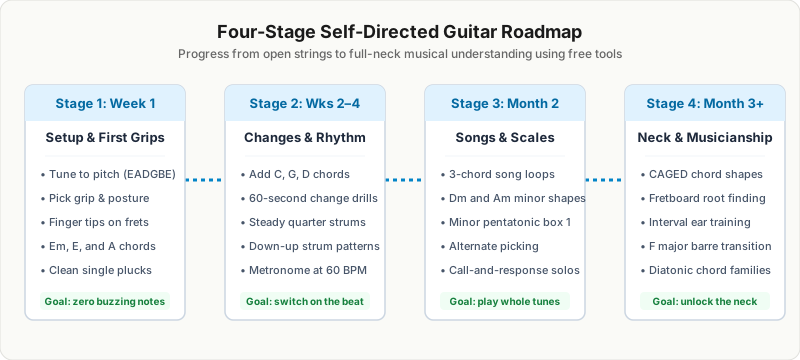
The four-stage free learning roadmap
Guitar technique is cumulative. Each stage introduces specific mechanics that directly support the next. Resist the urge to jump ahead to lead guitar licks before your rhythm hand can maintain a steady groove.
Stage 1: Week 1 — Setup, tuning, and first open chords
Establish an effortless setup ritual before fretting notes. An out-of-tune guitar sounds discordant regardless of finger accuracy.
- Tune every session: Use the browser Guitar Tuner before playing. Check standard EADGBE strings as explained in how to tune a guitar, tuning up into pitch to eliminate mechanical slack.
- Posture and pick grip: Sit upright on an armless chair with the neck tilted slightly up. Grip the pick between your thumb pad and index finger side, exposing 3–5 mm. Strum from the wrist.
- First open chords: Learn E minor (Em), E major (E), and A major (A) from Guitar Chords for Beginners.
- Clean pluck test: Fret each shape and pluck strings individually. Adjust your finger angle so fingertips stand perpendicular to the fretboard without muting adjacent strings.
Stage 2: Weeks 2 to 4 — Smooth chord changes and rhythm fundamentals
Switching between shapes in strict time is what turns chord grips into music.
- Add C major and G major: These open chords require wider finger separation. Keep your ring finger arched so the open G string rings cleanly on C.
- The 60-second change drill: Pick two chords (like G and C). Set a 60-second timer and count how many clean, ringing transitions you complete. Aim for 30 clean changes per minute.
- Rhythmic downstrums: Set a metronome to 60 BPM. Strum downward strictly on beats 1, 2, 3, and 4 without hesitating between chord shifts.
- Down-up strumming: Add eighth-note strums on the upbeat (1-& 2-& 3-& 4-&). Keep your strumming arm moving like a steady pendulum.
Stage 3: Month 2 — Real songs, chord vocabulary, and starter scales
Transition from isolated exercises into complete, recognizable songs.
- 3-chord song loops: Master progressions using G–C–D or Am–C–G. Hundreds of folk, blues, and pop standards rely entirely on these three-chord foundations.
- Expand chord vocabulary: Add A minor (Am) and D minor (Dm), comparing them against their major counterparts in our complete guitar chord chart.
- Learn the minor pentatonic scale: Practise Box 1 of the A minor pentatonic scale (5th fret) using alternate picking from our pentatonic scale guide.
- Visualise on the interactive fretboard: Test fingerings and hear plucks on the Virtual Guitar Lab to confirm note accuracy.
Stage 4: Month 3 and beyond — The whole neck, CAGED, and ear training
Expand beyond the first three frets to unlock the entire instrument.
- Map fretboard notes: Memorise natural notes on strings 6 (E) and 5 (A) to anchor moveable barre chords using Guitar Fretboard Notes.
- Understand the CAGED system: Study the CAGED system for guitar to see how the five open chord shapes connect end-to-end across the neck.
- Develop your musical ear: Dedicate ten minutes weekly to ear training to recognise intervals and chord qualities by sound.
- Tackle the F barre chord: Practise partial barres on the top four strings first. Roll your index finger slightly onto its bony side and pull gently from the shoulder.
Daily practice templates: 15, 30, and 60 minutes
Consistency beats marathon practice. Twenty focused daily minutes produces faster progress than a single weekend session.
15-Minute Maintenance Routine (Busy Days)
├─ 02 min: Tune guitar & check posture
├─ 03 min: Chromatic finger warm-up
├─ 05 min: 60-second chord change drills
└─ 05 min: Full song rhythm groove with metronome

30-Minute Core Routine (Recommended Daily)
├─ 03 min: Tune guitar & single-string clarity test
├─ 07 min: Targeted chord change transitions
├─ 10 min: Song repertoire practice with metronome
├─ 07 min: Pentatonic scale drills with alternate picking
└─ 03 min: Free exploration or improvising

60-Minute Deep Dive (Dedicated Sessions)
├─ 05 min: Tuning, warm-up, and ergonomics check
├─ 15 min: Strumming patterns and rhythm mechanics
├─ 20 min: Learning new song sections
├─ 10 min: Fretboard note memorisation & CAGED shapes
├─ 05 min: Ear training interval exercises
└─ 05 min: Review and free playing
Never skip tuning when time is short; practising out of tune damages your pitch perception.
The free browser toolkit for guitarists
You do not need paid mobile apps with monthly fees. Every essential tool is free in your browser:
- Guitar Tuner: Microphone-based pitch tracking with cents readout for standard EADGBE tuning.
- Metronome: Sample-accurate rhythm tool supporting subdivisions and tempo adjustments.
- Virtual Guitar Lab: Interactive fretboard for exploring chords, scales, and audio playback.
- Ear Training: Interval and chord quality listening quizzes.
- How to Practise with a Metronome: Exercises for timing stability and subdivision.
- Guitar Scales Guide: Complete reference for major, minor, and modal formulas.
When paid lessons make sense (and the truth about “virtual guitar lessons”)
While free online guitar lessons supply all core concepts, paid instruction makes sense in specific situations.
Free resources vs paid pre-recorded video courses
Commercial video platforms charge £15–£30 monthly for pre-recorded courses. However, pre-recorded video suffers from the same limitation as free video: it cannot watch you play. Paying a recurring subscription for pre-recorded lessons rarely solves mechanical plateaus.
When 1-on-1 virtual or in-person guitar lessons are worth paying for
Live instruction—whether in person or through one-on-one virtual guitar lessons over video calls—provides immediate feedback:
- Persistent physical pain: If playing causes wrist, forearm, or shoulder discomfort, an instructor can correct faulty posture immediately.
- Prolonged plateaus: If a chord transition or barre chord stalls for over a month, a tutor can pinpoint micro-mechanical faults like elbow angle or thumb placement.
- Rhythm struggles: A live teacher catches subconscious rushing or dragging that self-directed players overlook.
- Specialised styles: Advanced fingerstyle, jazz harmony, or classical technique benefit from direct mentorship.
When hiring an online guitar instructor, book occasional diagnostic sessions every few months rather than expensive weekly subscriptions.
Five common mistakes when learning guitar online
Avoid these five traps that stall self-directed guitarists:
1. Tutorial hopping
Jumping between disparate videos creates an illusion of learning without building finger dexterity. Stick to one structured plan for sixty days.
2. Gear obsession
Buying new pedals or guitars will not make chords ring cleaner. Prioritise finger calluses and low string action over gear. Consult our beginner guitar kit guide to avoid wasted spending.
3. Ignoring rhythm
Stopping between chord changes ruins musical flow. Strum an open muted string on beat 4 if necessary to keep time with the pulse.
4. Collecting riffs instead of songs
Learning ten two-bar intro riffs leaves you unable to play a full piece. Master complete three-minute songs from intro to outro.
5. Pushing through joint pain
Fingertip tenderness is normal callus formation; sharp wrist or tendon pain is not. Rest immediately and adjust your ergonomics to avoid strain.
Frequently asked questions
Can you really learn to play guitar online for free?
Yes. Guitar fundamentals, chords, and scales are public-domain knowledge. Free digital tuners, metronomes, and diagrams provide everything needed for fluency.
How long does it take to learn guitar online?
With 20–30 minutes of daily practice, expect:
- Month 1: 5–8 open chords and clean 4/4 strumming.
- Months 2–3: Dozens of 3-chord songs and minor pentatonic navigation.
- Month 6: Moveable barre chords, basic music theory, and jamming along with tracks.
Should I learn on an acoustic or electric guitar?
Electric guitars have lighter strings and lower action, making initial chords easier on fingers. Acoustic guitars build finger strength faster but cause more early soreness. Choose the instrument matching the music you love.
What is the difference between online guitar classes and self-paced video lessons?
Online guitar classes feature scheduled live sessions with teacher feedback. Self-paced online guitar lessons are pre-recorded materials you study on your own schedule.
How do I know if my guitar needs a setup?
If pressing strings at the 1st fret requires excessive force, or strings sit more than 2.5 mm above the 12th fret, have a luthier lower the action.
Related tools
- Virtual Guitar Lab — interactive fretboard for exploring open chords, moveable shapes, and scales.
- Guitar Tuner — microphone-driven EADGBE pitch tracking with precision cents indicator.
- Metronome — rock-solid tempo, subdivision, and time signature practice tool.
- Ear Training — develop relative pitch, interval recognition, and chord quality identification.
- Guitar Chords for Beginners — step-by-step fingering diagrams for the first eight open chords.
- Guitar Chord Chart — comprehensive visual reference for major, minor, and seventh chords.
- Pentatonic Scale for Guitar — five moveable box patterns for minor and major pentatonic improvisation.
- CAGED System for Guitar — master the five moveable shapes that connect chords and scales across the entire neck.