
Pentatonic Scale for Guitar: Minor & Major in 5 Boxes
Learn the pentatonic scale on guitar: minor and major formulas, the five A-minor box shapes with diagrams, the relative-major shortcut, and starter licks.
The pentatonic scale on guitar is a five-note-per-octave scale that sits under most rock, blues, country, and pop soloing. The minor pentatonic formula is 1 – b3 – 4 – 5 – b7, and the major pentatonic formula is 1 – 2 – 3 – 5 – 6.
Those five notes are arranged into five compact “box” shapes that tile the whole fretboard. Learn one box and you can solo in one position; learn all five and you can play the same scale anywhere on the neck. This guide teaches the boxes in A minor, shows how the identical shapes become C major, and gives you a practice method plus three original starter licks. Try everything here on the Virtual Guitar Lab, which sounds each note as you click it.
Printable PDF: Download the pentatonic scale boxes cheat sheet — all five box shapes with root markers and relative major roots on one print-friendly sheet.
Minor vs major pentatonic: the two formulas
Both scales contain five notes, but they start from different places and serve different moods. The minor pentatonic sounds tense and bluesy; the major pentatonic sounds open and sweet. The practical surprise is that on guitar they share the exact same box shapes — only the root note moves.
| Minor pentatonic | Major pentatonic | |
|---|---|---|
| Formula | 1 – b3 – 4 – 5 – b7 | 1 – 2 – 3 – 5 – 6 |
| A root spells | A – C – D – E – G | A – B – C# – E – F# |
| C root spells | C – Eb – F – G – Bb | C – D – E – G – A |
| Mood | Bluesy, tense, dominant-friendly | Sweet, open, country and pop |
| Home chord | Minor and dominant-7th chords | Major chords |
| Typical use | Rock and blues solos over minor or 12-bar progressions | Melodies and solos over major progressions |
Memorise the pair this way: the minor pentatonic is a natural minor scale with the 2nd and 6th degrees removed; the major pentatonic is a major scale with the 4th and 7th degrees removed. The removed notes are the semitone-heavy ones, which is why pentatonic lines rarely clash with the backing chords. To see how these five-note shapes fit into full seven-note major scales, natural minor, and modal frameworks, explore our comprehensive guitar scales guide.
If you know your note names already, the boxes below will click faster. If not, read Guitar Fretboard Notes first, then come back.
The five box shapes in A minor
A minor pentatonic contains the notes A, C, D, E, and G. Each box below shows two notes per string inside a small fret window. Blue dots mark the root notes (A) — always orient yourself by the roots before playing anything else. String labels on the left read low E at the top, high E at the bottom, and the numbers across the top are fret numbers.
Box 1: frets 5–8 (start here)
Box 1 is the shape every guitarist learns first. Its root sits under your index finger on the low E string at fret 5, and the shape spans just four frets, so no stretching is needed.
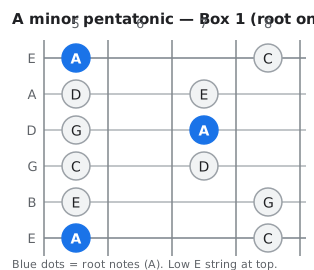
Fret by fret, low string to high: E string 5–8 (A–C), A string 5–7 (D–E), D string 5–7 (G–A), G string 5–7 (C–D), B string 5–8 (E–G), high E string 5–8 (A–C). The three roots form a triangle: low E fret 5, D string fret 7, high E fret 5. Practise this box ascending and descending until you can find all three roots without looking at the diagram.
Box 2: frets 7–10
Box 2 starts where Box 1 ends — the C and D on the E strings at frets 8 and 10 are shared between the two shapes. Its roots sit on the D string at fret 7 and the B string at fret 10.
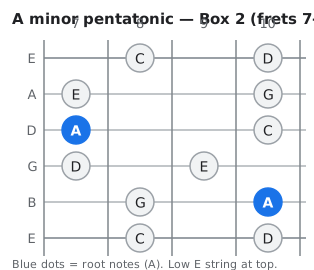
Fret by fret: E string 8–10 (C–D), A string 7–10 (E–G), D string 7–10 (A–C), G string 7–9 (D–E), B string 8–10 (G–A), high E string 8–10 (C–D). Notice the G string only spans frets 7–9 here — the compact two-fret reach is the signature of this box. The common mistake is sliding the whole hand up to fret 8 and losing the index finger’s anchor on fret 7; keep your index over fret 7 on the middle strings.
Box 3: frets 9–13
Box 3 centres on the A root at fret 12 on the A string — the octave of the open A — which makes it easy to find. It shares the D–E on the low E string (frets 10–12) with Box 2.
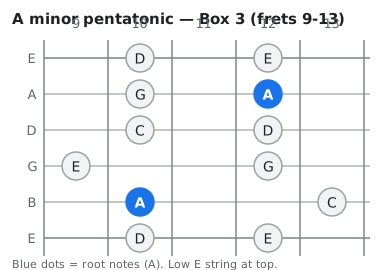
Fret by fret: E string 10–12 (D–E), A string 10–12 (G–A), D string 10–12 (C–D), G string 9–12 (E–G), B string 10–13 (A–C), high E string 10–12 (D–E). The B string reaching fret 13 is the widest stretch in the system; play frets 10 and 13 on that string with your index and little finger. If the stretch hurts, play the C on the high E string at fret 8 instead while you build finger strength — then come back and own the stretch.
Box 4: frets 12–15
Box 4 sits exactly one octave above open position, so every note matches an open-string-plus-12 equivalent. Its roots are on the A string at fret 12 and the G string at fret 14.
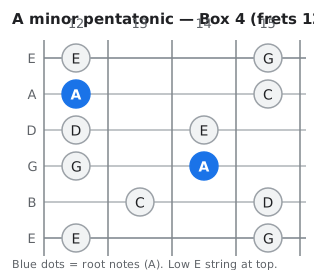
Fret by fret: E string 12–15 (E–G), A string 12–15 (A–C), D string 12–14 (D–E), G string 12–14 (G–A), B string 13–15 (C–D), high E string 12–15 (E–G). Because fret 12 is the octave, use this box to check your intonation and your ear: play the A at fret 12 on the A string, then the open A string, and the two should match perfectly on a tuned guitar. If they do not, visit the Guitar Tuner before practising further.
Box 5: frets 14–17
Box 5 wraps around the top of the neck and connects back down to Box 1 — the G and A on the low E string at frets 15 and 17 are the same notes as frets 3 and 5 an octave lower. Its roots sit on the low E string at fret 17, the G string at fret 14, and the high E string at fret 17.
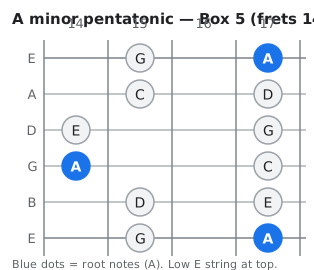
Fret by fret: E string 15–17 (G–A), A string 15–17 (C–D), D string 14–17 (E–G), G string 14–17 (A–C), B string 15–17 (D–E), high E string 15–17 (G–A). Subtract 12 from every fret number and you get the open-position version (frets 2–5), which is worth learning separately: E string 3–5, A string 3–5, D string 2–5, G string 2–5, B string 3–5, high E string 3–5. Same notes, same roots, no high-fret squeezing.
How the boxes connect
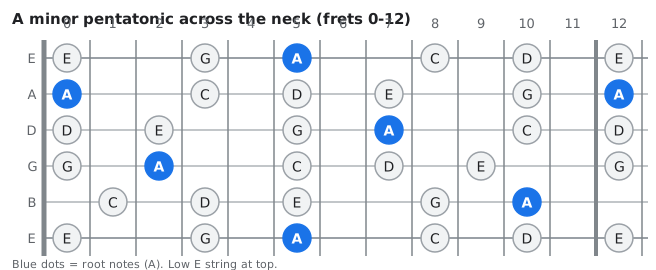
The five boxes are not five separate scales — they are five windows onto one continuous pattern. The full-neck map below shows every A minor pentatonic note from the open strings to fret 12. Trace Box 1 at frets 5–8, then Box 2 at 7–10, and you will see they share a border of notes rather than sitting side by side.
Two connection habits make the neck feel like one scale instead of five shapes:
- Share the seams. When moving from Box 1 to Box 2, play the shared C–D pair on the high E string (frets 8–10) as your bridge. Every neighbouring pair of boxes shares exactly one two-note seam per string — find it and walk through it.
- Follow the roots. The A roots march diagonally up the neck: low E fret 5, D string fret 7, B string fret 10, A string fret 12, G string fret 14, high E fret 17. Sliding between neighbouring roots (for example, D string fret 7 up to B string fret 10) moves you between boxes without memorising anything new.
This diagonal-root layout is the same idea behind the CAGED System: the scale boxes and the chord shapes lock together around the same root notes.
The relative major shortcut: A minor is C major
Here is the shortcut that halves the memorisation: A minor pentatonic contains exactly the same notes as C major pentatonic (C–D–E–G–A). Play any box above, but treat C as home instead of A, and you are playing major pentatonic. The shapes do not move; only your ear’s target changes.
Concretely, in Box 1 (frets 5–8), resolve your phrases to the C notes — A string fret 3 is below the box, but inside it you have C on the low E string at fret 8, C on the G string at fret 5, and C on the high E string at fret 8. End licks on those C notes over a C major backing and the line sounds major; end the identical lick on the A roots and it sounds minor.
The same relationship holds for every pair in this guide: E minor shares all notes with G major, and D minor shares all notes with F major. If a song is in G major and you only know minor boxes, play your E minor boxes and aim for G notes. To understand why keys pair up this way, explore the Circle of Fifths, which shows every relative major–minor pair on one wheel.
Key-by-key box positions
Moving the system to a new key means sliding every box so the roots land on the new root note. The table gives, for each requested key, the scale notes, an equivalent relative key whose boxes you already know, and the fret where Box 1’s low-E root sits. Everything else — the shapes, the seams, the root patterns — stays identical.
| Key | Type | Notes | Same shapes as | Box 1 low-E root fret |
|---|---|---|---|---|
| A minor | minor | A – C – D – E – G | — (learn as written) | 5 |
| C minor | minor | C – Eb – F – G – Bb | — | 8 |
| D minor | minor | D – F – G – A – C | F major | 10 |
| E minor | minor | E – G – A – B – D | G major | 12 (or open 0) |
| G minor | minor | G – Bb – C – D – F | Bb major | 3 |
| A major | major | A – B – C# – E – F# | F# minor (Box 1 root fret 2) | 2 (as F# minor) |
| C major | major | C – D – E – G – A | A minor (this guide) | 5 (as A minor) |
| E major | major | E – F# – G# – B – C# | C# minor (Box 1 root fret 9) | 9 (as C# minor) |
| G major | major | G – A – B – D – E | E minor (Box 1 root fret 12/0) | 12 (as E minor) |
Two worked examples. For E minor, slide every A-minor box up 7 frets (or think down 5): Box 1’s low-E root moves from fret 5 to fret 12, and Box 5’s open-position version becomes genuinely open — frets 0–3 with open strings ringing. For G major, use the relative shortcut instead of shifting: play your E minor boxes (Box 1 root at fret 12 or open) and resolve to G notes. Shifting shapes is mechanical; hearing the new home note is the actual skill, so always finish a transposition exercise by playing the new root three times and holding it.
How to practise: one box per week
A five-week plan beats a five-hour cram session. Spend one week per box, about 15 minutes a day:
- Days 1–2: roots first. Play only the root notes in the box, up and down, naming each “A” aloud. Then add the remaining notes ascending and descending with alternate picking or alternate fingers.
- Days 3–4: add the metronome. Set the Metronome to 60 bpm and play quarter notes, then eighth notes, through the box. Only raise the tempo when a full pass is clean — speed is a byproduct of accuracy, not its cause.
- Days 5–7: call and response. Play a two-bar phrase from the box in the Virtual Guitar Lab, then answer it with your own two bars on your real guitar (or in the Lab). Limit yourself to the current box plus any previously learned ones.
Each week, spend the last session sliding between the new box and its neighbour through their shared seam. By week five you will be crossing all five boxes without thinking about box numbers — which is the entire point.
Three starter licks (original etudes)
These three short phrases were written for this guide. They use only A minor pentatonic notes and are described string by string with fret numbers, so you can play them in the Virtual Guitar Lab or on your own guitar. Notation reads as string: fret-sequence, for example “high E: 5–8” means play fret 5 then fret 8 on the high E string.
Lick 1 — “Doorstep” (Box 1, ascending answer-phrase). High E: 5–8, B: 5–8, G: 7–5, D: 7. Rhythm: play the first six notes as steady eighth notes and hold the final D-string fret 7 (an A root) for a full bar. The phrase climbs one octave from A to A and lands home, which trains your ear to hear the root as a destination. Repeat it three times, then change only the last note to G-string fret 5 (a C) and notice how unfinished it feels — that contrast is the sound of resolution.
Lick 2 — “Seam Walker” (Boxes 1–2 crossing). B: 8–10, high E: 8–10, high E: 10–8, B: 10–8, G: 9–7. This walks up the shared Box 1/Box 2 seam on the top strings and back down, crossing the box boundary twice. Play it slowly with a slight pause on the B-string fret 10 (an A root) each time you pass it. Once smooth, start the same pattern one string lower (G: 7–9, D: 7–10…) to feel how the seam continues across the neck.
Lick 3 — “Thirds Down” (Box 1, descending in thirds). High E: 8–5, B: 8–5, high E: 5, B: 8–5, G: 7–5, D: 7–5. The line falls in little two-note steps — C to A, G to E — then resolves down to the D-string roots. It sounds more musical than a straight scale run because thirds outline the underlying chords. Loop it over any A minor backing and vary the rhythm: straight the first time, then delay the second note of each pair by half a beat.
Printable cheat sheet
Pin the boxes to your music stand. The printable PDF shows all five A-minor box shapes with root markers, plus the relative C-major root for each box so you can practise the major shortcut on paper.
Related tools
- Virtual Guitar Lab — hear every box and lick in this guide, then build your own phrases.
- Guitar Scales — charts and five CAGED positions for major, minor, and modal scales.
- Circle of Fifths — find relative major–minor pairs and key signatures for transposing the boxes.
- CAGED System for Guitar — how these scale boxes lock together with moveable chord shapes.
- Guitar Fretboard Notes — the full note map behind every box.
- Metronome — time your box practice and raise tempos cleanly.
- Guitar Tuner — check tuning against 12th-fret octaves before scale practice.