
Circle of Fifths — Interactive Wheel & Guitar Guide
Explore the interactive circle of fifths: pick any key, see its signature and chords, hear them on guitar, and print the chart.
Tool controls
How it works
First-party plucked-string-style synthesis on the Web Audio API. Each chord voice pairs a triangle-wave fundamental with a quiet octave harmonic through a lowpass filter, with a fast attack and a long decay, staggered low string to high string like a strum. The wheel, key signatures and diatonic chords come from the site's shared music-theory data. Nothing is downloaded and no audio leaves the device.
On this page
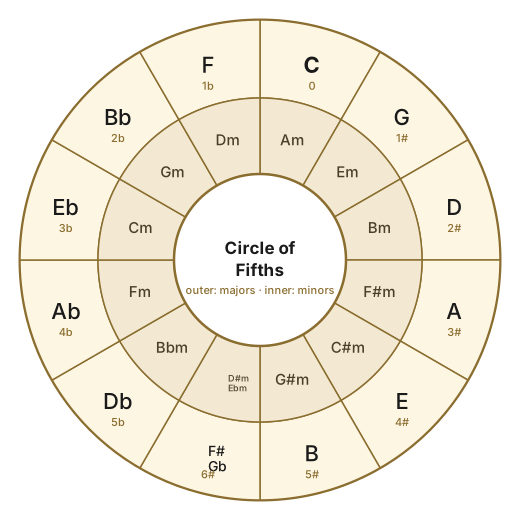
The circle of fifths is a wheel that organises all twelve major keys in a ring, each a perfect fifth above the last. Keys that sit next to each other share nearly all their notes, so the diagram answers three practical questions at a glance: how many sharps or flats a key has, which minor key goes with each major, and which chords sound at home together. Click any segment of the wheel above to select a key — the readout shows its signature and its seven diatonic chords, and every chord plays when you click it.
Printable PDF: Download the circle of fifths chart — twelve major keys on the outer ring, relative minors inside, and every key signature on one print-friendly page.
How to read the wheel
Start at the top with C major: no sharps, no flats. Move clockwise and each step adds one sharp — G has one (F♯), D has two (F♯, C♯), A three, E four, B five — until F♯/G♭ at the bottom with six. Move anticlockwise from C instead and each step adds one flat — F has one (B♭), B♭ has two, E♭ three, A♭ four, D♭ five. The bottom of the wheel is where the two sides meet: F♯ major (six sharps) and G♭ major (six flats) sound identical and are written as one segment with both names.
The inner ring holds the relative minors. Every major key shares its key signature with exactly one minor key, built from the sixth degree of its scale. C major pairs with A minor, G major with E minor, F major with D minor, and so on around the ring. Selecting an inner segment switches the tool to that minor key and rebuilds the chord list around the natural minor pattern instead.
Two habits make the wheel stick. First, notice that neighbours differ by exactly one accidental: C–G differ only on F vs F♯, G–D only on C vs C♯. Modulation between adjacent keys therefore sounds smooth, which is why songs drift to the next segment for a lift. Second, opposite sides of the wheel are the most distant keys — C major and F♯/G♭ major share almost nothing — so jumping across the wheel sounds dramatic and needs careful handling.
Every key at a glance
| Major | Relative minor | Sharps | Flats |
|---|---|---|---|
| C | Am | 0 | 0 |
| G | Em | 1 (F♯) | 0 |
| D | Bm | 2 (F♯, C♯) | 0 |
| A | F♯m | 3 (F♯, C♯, G♯) | 0 |
| E | C♯m | 4 (F♯, C♯, G♯, D♯) | 0 |
| B | G♯m | 5 (F♯, C♯, G♯, D♯, A♯) | 0 |
| F♯ / G♭ | D♯m / E♭m | 6 | 6 |
| D♭ | B♭m | 0 | 5 (B♭, E♭, A♭, D♭, G♭) |
| A♭ | Fm | 0 | 4 (B♭, E♭, A♭, D♭) |
| E♭ | Cm | 0 | 3 (B♭, E♭, A♭) |
| B♭ | Gm | 0 | 2 (B♭, E♭) |
| F | Dm | 0 | 1 (B♭) |
Guitarists meet the sharp side first — G, D, A and E are the open-chord keys — while flat keys like B♭ and E♭ turn up wherever horns and keyboards lead. The wheel above spells every chord to match its key, so B♭ major’s chords read with flats (B♭, Cm, Dm, E♭) rather than awkward sharp equivalents.
Diatonic chords: the families every key owns
Each key contains seven chords built from its own scale, with qualities that never change. In a major key the pattern is I–ii–iii–IV–V–vi–vii° (major, minor, minor, major, major, minor, diminished). Here it is for C major, the key with no accidentals to hide behind:
| Chord | Notes | Quality | Role |
|---|---|---|---|
| C (I) | C E G | Major | Tonic — home |
| Dm (ii) | D F A | Minor | Supertonic |
| Em (iii) | E G B | Minor | Mediant |
| F (IV) | F A C | Major | Subdominant |
| G (V) | G B D | Major | Dominant — pulls home |
| Am (vi) | A C E | Minor | Submediant — the relative minor |
| Bdim (vii°) | B D F | Diminished | Leading tone — tense, resolves up |
The minor pattern, shown here for A minor, is i–ii°–III–iv–v–VI–VII:
| Chord | Notes | Quality | Role |
|---|---|---|---|
| Am (i) | A C E | Minor | Tonic — home |
| Bdim (ii°) | B D F | Diminished | Supertonic |
| C (III) | C E G | Major | Mediant |
| Dm (iv) | D F A | Minor | Subdominant |
| Em (v) | E G B | Minor | Dominant (natural minor keeps it minor) |
| F (VI) | F A C | Major | Submediant |
| G (VII) | G B D | Major | Subtonic |
Compare the two tables and a useful truth falls out: C major and A minor contain exactly the same seven chords in a different order. That is what “relative” means in practice — the same material, a different home. Select C on the wheel, play I–vi–IV–V (C–Am–F–G), then flip to the relative minor and hear how Am–F–C–G leans on the same chords with a darker centre of gravity.
How guitarists actually use it
Finding a song’s key. Most pop, rock, folk and country songs live on three or four neighbouring chords. If you hear G, C, D and Em, the wheel confirms all four belong to G major — G is I, C is IV, D is V, Em is vi. That single lookup replaces guessing through all twelve keys, and it tells you the seventh chord (F♯dim) is the one to avoid unless you want tension.
Transposing with a capo. Suppose a song in G uses G–C–D–Em but the singer needs it a whole step higher, in A. A capo on fret 2 with the same G shapes does it — and the wheel explains why the result is correct: G major and A major are neighbours, so every shape keeps its function (I stays I, IV stays IV). Transposing up a fifth works the same way: capo 7 turns G shapes into D shapes, one more step clockwise.
Chord families and common progressions. The progressions guitarists play most are wheel neighbours. I–V–vi–IV in G is G–D–Em–C: open G and C shapes, a D that rings against them, and Em as the soft centre. I–vi–IV–V (G–Em–C–D) is the same family reordered. The 12-bar blues in A (A–D–E) is I–IV–V with dominant sevenths, and the Andalusian i–VII–VI–V in E minor (Em–D–C–B) walks down the minor side. The Set on the fretboard button below opens the Virtual Guitar Lab, so you can move from hearing the family to fretting it with real voicings. For the shapes themselves, the beginner chords guide and the printable chord chart cover fingerings in detail, including the F barre and B minor shapes beginners meet first. The Progressions group below the chord buttons plays three of these loops — a pop I–V–vi–IV in G, a jazz ii–V–I in C with seventh-chord colours, and a 12-bar blues in A — using the same guitar voice and highlighting each chord as it sounds; picking another key stops the loop.
Writing bridges and key changes. A bridge that moves one segment clockwise (say, from a G-major verse to a D-major lift) adds exactly one new sharp and sounds like sunrise. Moving to the relative minor darkens a bridge without changing the signature at all. Both moves are visible on the wheel before a single note is played.
Circle of fifths piano
Everything above holds on piano, and pianists get one extra visual gift: the circle of fifths piano layout maps directly onto key colour. C major is all white keys. Each clockwise step adds one black key (G needs F♯, D needs F♯ and C♯), and each anticlockwise step trades a white key for a flat. That is why piano teachers introduce G and F before D and B♭ — the hand learns one black key at a time. Try the same key on both instruments: select D major here, play its I–vi–IV–V, then find those chords on the Virtual Piano and feel how the two-sharp signature sits under the fingers.
Circle of fifths bass clef
Bass lines love fifths because the interval is stable under almost any chord: root–fifth movement (C–G, A–E) anchors the harmony without cluttering it. The wheel is literally a map of those jumps — every clockwise step is the fifth above. Walking roots around the wheel (C–G–D–A–E…) is a standard fingerboard drill. When reading standard notation, using the circle of fifths bass clef key signatures works identically to treble clef, so the readout above functions as printed. Tune up with the online guitar tuner first if you are on a bass with guitar-style machine heads, and keep time with the metronome while drilling the cycle at 60 BPM.
Practise routine and printable chart
A ten-minute routine with the wheel above: pick a major key, play its I–IV–V slowly, then its vi and ii, naming each roman numeral aloud; flip to the relative minor and repeat i–VI–VII; move one segment clockwise and start over. Two weeks of that across the sharp-side keys (C, G, D, A, E) teaches transposition by ear rather than by memorised shapes.
Download the printable PDF to keep the wheel on your music stand: twelve majors outside, relative minors inside, every key signature on one page. Pair it with the fretboard map in the fretboard notes guide when you are ready to connect each key to its positions on the neck.
Related tools
- Virtual Guitar Lab — fret the chords from any key on a playable neck
- Guitar Tuner — standard EADGBE tuning before you practise
- Virtual Piano — hear the same keys and signatures on keys
- Metronome — keep steady time while drilling key changes
Frequently asked questions
What is the circle of fifths in simple terms?
It is a diagram that arranges the twelve major keys in a ring, each one a perfect fifth above the last. Neighbouring keys share most of their notes, so the wheel shows at a glance which keys are closely related, how many sharps or flats each key signature has, and which chords belong together.
How do I read the outer and inner rings of the wheel?
The outer ring names the twelve major keys, from C at the top with no sharps or flats, clockwise through G, D, A, E and B (adding sharps) and anticlockwise through F, Bb, Eb, Ab and Db (adding flats). The inner ring names each major key's relative minor — the minor key that shares the same key signature — so Am sits inside C, Em inside G, and so on.
What are the diatonic chords of a key?
They are the seven chords built from the notes of that key's scale, with fixed qualities: in a major key the pattern is major, minor, minor, major, major, minor, diminished (I–ii–iii–IV–V–vi–vii°). Click any key on the wheel above and the tool lists all seven with their roman numerals, and plays each one when you click it.
How do guitarists use the circle of fifths?
Three everyday ways: finding which chords belong in a song's key (the I, IV, V and vi cover most pop and rock), transposing with a capo (move the shape and let the wheel tell you the new key), and borrowing the relative minor for verses and bridges. The wheel above plays every diatonic chord so you can hear each family before fretting it.
What is the relative minor of each major key?
The relative minor shares the major key's key signature and sits a minor third (three semitones) below its tonic: Am is the relative minor of C, Em of G, Dm of F, and so on. Select any major key on the wheel and the readout names its relative minor; the switch button flips between the two so you can compare their chord families.
Does the circle of fifths work for piano and bass too?
Yes. The key signatures and chord families are the same on every instrument. Pianists exploring the circle of fifths piano layout often start from C, G and F because those sit mostly on white keys, and bass players use the wheel to walk roots in fifths (C–G–D–A). The circle of fifths bass clef key signatures match treble clef note-for-note.
Is there a printable circle of fifths chart?
Yes. [Download the printable PDF](/downloads/circle-of-fifths.pdf) with the twelve major keys on the outer ring, the relative minors inside, and every key signature. It prints on one page and fits in a guitar case or on a music stand.