
Guitar Chord Chart: Printable Diagrams for Every Common Chord
Free printable guitar chord chart: open majors, minors, sevenths and movable barre shapes with fingerings, plus blank grids for teachers.
Designed as an accessible guitar chord chart for beginners, this reference covers the core voicings every guitarist needs: five open majors, three open minors, five dominant sevenths, and the two movable barre shapes that unlock the rest of the neck. While players often search for a single guide with all guitar chords for beginners, attempting to learn hundreds of chord shapes at once is counterproductive; instead, using this basic guitar chord chart lets you master the foundational shapes that power thousands of songs. Every diagram below shows finger numbers — print the page or grab the PDF and keep it where you practise.
If you are learning these shapes for the first time, start with our step-by-step companion, Guitar Chords for Beginners, which teaches the eight essential chords with practice drills. This page is the reference shelf; that page is the course.
Printable PDF: Download the guitar chord chart — every chord on this page as fingered grids on one print-friendly sheet; a blank worksheet is included.
How to read these diagrams
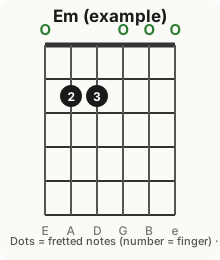
Each grid shows the first five frets as seen facing the guitar neck. The six vertical lines are the strings, low E on the left and high E on the right; the horizontal lines are the frets, with the thick top line representing the nut.
- Black dots mark fretted notes; the white number inside is the suggested finger (1 = index, 2 = middle, 3 = ring, 4 = little).
- O above a string means play it open; X means skip it — mute it or miss it with the pick.
- The curved bar on barre diagrams means one finger (always the index) presses several strings at the same fret.
- “2fr” labels mean the grid starts at the 2nd fret rather than the nut — slide the whole shape up accordingly.
Hear any chord before you finger it in the Virtual Guitar Lab. For a comprehensive breakdown of chord-box symbols, barre notation, capo rules, and chord formulas, see our guide on how to read guitar chord charts.
Open major chords
The five shapes below are the foundation of rhythm guitar — and the same shapes the CAGED System uses to map the whole neck.
| Chord | Diagram | Frets (6→1) | Fingers |
|---|---|---|---|
| E major | 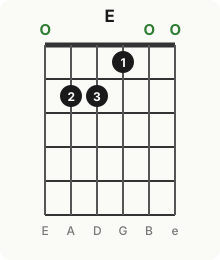 |
0-2-2-1-0-0 | — 2 3 1 — — |
| A major | 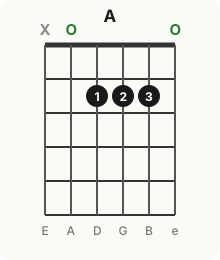 |
X-0-2-2-2-0 | — — 1 2 3 — |
| D major | 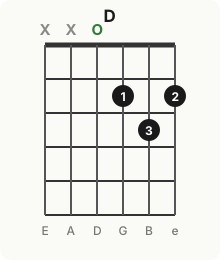 |
X-X-0-2-3-2 | — — — 1 3 2 |
| G major | 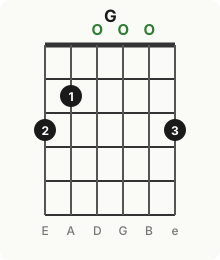 |
3-2-0-0-0-3 | 2 1 — — — 3 |
| C major | 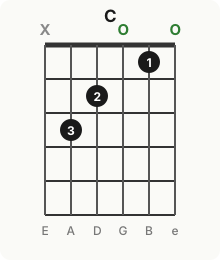 |
X-3-2-0-1-0 | — 3 2 — 1 — |
Strum E and G across all six strings; start A, C from the 5th string; start D from the 4th. Keep the thumb behind the neck so each fingertip lands vertically — the most common fault in these shapes is a flat finger silencing the open string next to it.
Open minor chords
Minor chords flatten the third of the matching major chord by one semitone — one finger moves, and the mood changes completely.
| Chord | Diagram | Frets (6→1) | Fingers |
|---|---|---|---|
| Em | 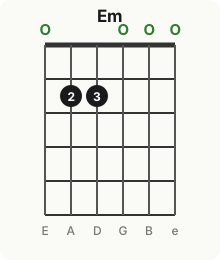 |
0-2-2-0-0-0 | — 2 3 — — — |
| Am | 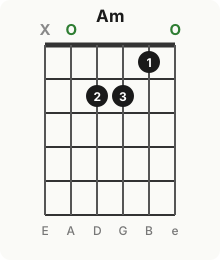 |
X-0-2-2-1-0 | — — 2 3 1 — |
| Dm | 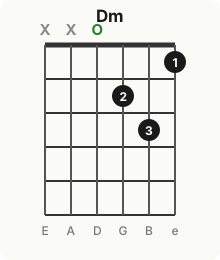 |
X-X-0-2-3-1 | — — — 2 3 1 |
Compare E with Em (only the index on the 3rd string moves) and D with Dm (the triangle flips). Practising each major/minor pair back to back is the fastest way to hear what “minor” actually means.
Seventh chords
Dominant seventh chords add a flattened seventh above the root, giving the restless, bluesy pull toward the home chord — G7 wants to resolve to C, D7 to G, A7 to D, E7 to A. Use them wherever a song feels too settled on the plain major.
| Chord | Diagram | Frets (6→1) | Fingers |
|---|---|---|---|
| E7 | 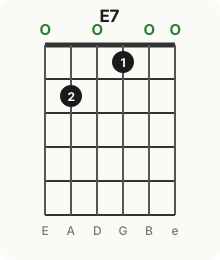 |
0-2-0-1-0-0 | — 2 — 1 — — |
| A7 | 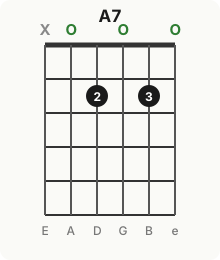 |
X-0-2-0-2-0 | — — 2 — 3 — |
| D7 | 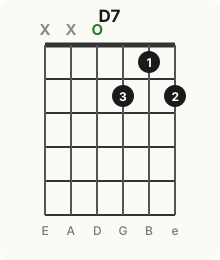 |
X-X-0-2-1-2 | — — — 3 1 2 |
| G7 | 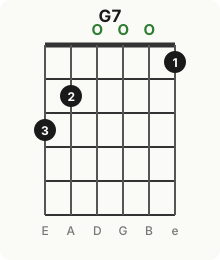 |
3-2-0-0-0-1 | 3 2 — — — 1 |
| C7 | 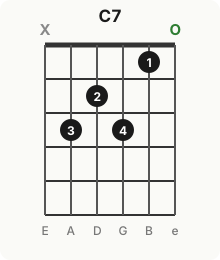 |
X-3-2-3-1-0 | — 3 2 4 1 — |
E7, A7 and D7 are genuinely easy — each is its major shape with one finger lifted. G7 and C7 take more work; learn them after the first three. Preview the resolutions (try A7 → D, E7 → A) in the Virtual Guitar Lab before drilling them on your guitar.
Movable barre shapes
Open chords run out at the 4th fret. These two barre shapes move anywhere: fret them at any position and you get a new chord with the same quality, named by the root under your index or middle finger. Learn where the roots sit in Guitar Fretboard Notes and the shapes become a complete system.
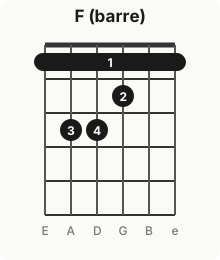
F major (E-shape barre, 1st fret). Index bars all six strings at fret 1; ring, little and middle form the E-major shape above it (frets 3-3-2 on strings 5-4-3). Keep the index close to the fret wire and roll it slightly onto its bony side. If the inner strings buzz, move the middle finger’s pressure onto the outer strings by shifting your elbow forward.
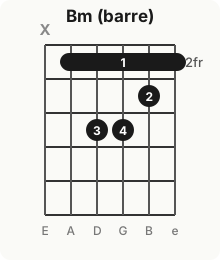
B minor (Am-shape barre, 2nd fret). Index bars strings 1–5 at fret 2; ring and little take strings 4–3 at fret 4; middle takes string 2 at fret 3. The 6th string stays muted. This is most players’ first minor barre — practise it as Am slid up two frets with the index added behind.
Honest advice: half-barres (three to four strings) are legitimate stepping stones, and clean barres take most beginners six to ten weeks. Never practise them with a death grip — if your thumb aches, you are squeezing instead of positioning.
Playing with a capo
A capo clamps across the fretboard and acts as a movable nut: with a capo on fret 2, a G-shape chord sounds as A. That is why the open shapes on this chart stay useful forever — the capo transposes them without new fingerings.
Transpose by counting semitones from the shape’s natural root: capo 2 raises everything a whole step (C shape → D, A shape → B, G shape → A, E shape → F♯, D shape → E). Retune first with the Guitar Tuner — the capo pulls strings slightly sharp, so check tuning after clamping, especially on the B string.
Blank worksheet for teachers and students
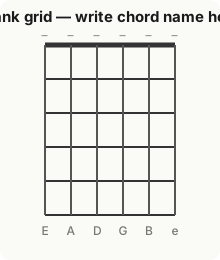
Writing a chord down by hand is one of the best ways to memorise it. Use blank grids to copy shapes from this chart from memory, to notate voicings you discover in the Virtual Guitar Lab, or (for teachers) as dictation sheets: call out “G7” and have the student draw the dots and finger numbers.
Download the printable PDF for a full page of empty grids.
PDF downloads
- Download the printable PDF — save our free printable guitar chord chart pdf with every chord on this page as fingered grids on one print-friendly sheet.
- Download the printable PDF — blank grids for lessons, homework and your own voicings.
Both files are free, print cleanly at A4 or US Letter, and match the diagrams above exactly.
Related tools
- Virtual Guitar Lab — hear every chord on this chart and experiment with your own shapes.
- How to Read Guitar Chord Charts — symbols, numbers, barre notation, and chord symbols decoded.
- Guitar Chords for Beginners — the step-by-step course behind this reference.
- Guitar Tuner — tune to EADGBE before practising or printing checks.
- Metronome — drill chord changes in time.
- Circle of Fifths — which chords belong together in each key.