
Guitar Fretboard Notes: Complete Chart, Diagram & Memorization Guide
Every note on the guitar fretboard: full 0–12 diagram, per-string charts, open-string frequencies, octave shapes, and a 2-week memorization plan.
The six open strings of a standard-tuned guitar, from lowest to highest, are E, A, D, G, B, E. Every fret raises the pitch by one semitone, and the twelve notes repeat in the order E–F–F♯–G–G♯–A–A♯–B–C–C♯–D–D♯ (then back to E), so the 12th fret of any string plays the same note as its open string, one octave higher.
Whether you are studying guitar notes for beginners, practising beginner guitar notes for the first time, or building an internal guitar fretboard map, mastering the fretboard notes guitar players rely on is what unlocks chords, scale boxes, and creative freedom. Once you understand how guitar notes on fretboard positions repeat, the fretboard stops feeling like an arbitrary grid. The rest of this guide is a complete guitar notes chart and fretboard reference you can return to: a full-neck diagram, a table for every string, the open-string frequencies, the shortcuts experienced players actually use, and a two-week plan for memorising the neck.
Printable PDF: Download the guitar fretboard notes chart — every note from frets 0 to 12 across all six strings on one print-friendly sheet.
Full guitar fretboard diagram: frets 0–12
The guitar fretboard diagram below shows every note on a standard-tuned guitar (EADGBE) from the open strings to the 12th fret. Acting as an all-in-one guitar neck notes diagram, blue dots represent natural notes (A, B, C, D, E, F, G) while dark dots mark sharps. String 1 (high E) is at the top.
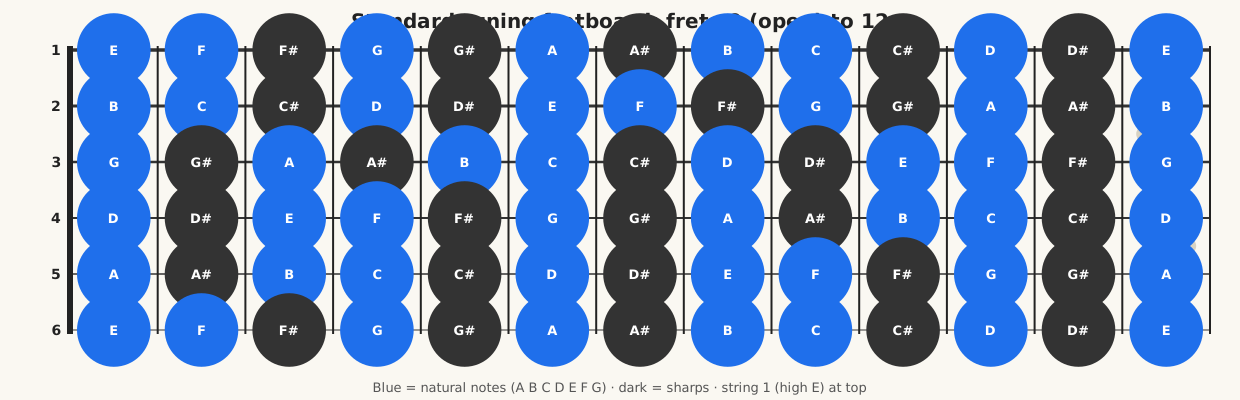
Two things are worth noticing before you scroll to the guitar fretboard notes chart below. First, there is no sharp between B and C or between E and F — those pairs are already a semitone apart, which is why the pattern of dots looks uneven. Second, fret 12 mirrors the open strings exactly: E–A–D–G–B–E. Everything past the 12th fret is a repeat of frets 0–12, one octave higher, so learning the first twelve frets means you already know the whole neck.
Download the printable guitar fretboard notes pdf to have printable guitar fretboard notes on your music stand while you work through the plan below.
Notes on each string, fret 0–12
Below is a complete guitar notes on neck chart detailing the individual guitar notes strings layout. Learning to visualise guitar notes on neck positions string by string is the most reliable way to build permanent muscle memory. Sharps are written with ♯ below; each sharp is the same pitch as the flat of the next natural note (F♯ = G♭, and so on). Guitarists in standard tuning normally say “sharp” rather than “flat” when naming fret positions, so the tables use sharps throughout.
String 6 — low E
| Fret | 0 | 1 | 2 | 3 | 4 | 5 | 6 | 7 | 8 | 9 | 10 | 11 | 12 |
|---|---|---|---|---|---|---|---|---|---|---|---|---|---|
| Note | E | F | F♯ | G | G♯ | A | A♯ | B | C | C♯ | D | D♯ | E |
The low E string is the reference edge of the neck and the anchor of any guitar neck notes chart. Learn it first: the dots at frets 3 (G), 5 (A), 7 (B), 9 (C♯), and 12 (E) are the landmarks everything else hangs off.
String 5 — A
| Fret | 0 | 1 | 2 | 3 | 4 | 5 | 6 | 7 | 8 | 9 | 10 | 11 | 12 |
|---|---|---|---|---|---|---|---|---|---|---|---|---|---|
| Note | A | A♯ | B | C | C♯ | D | D♯ | E | F | F♯ | G | G♯ | A |
The A string carries the same landmarks shifted: fret 3 is C, fret 5 is D, fret 7 is E, fret 10 is G. Most barre chords root here, so this string repays memorisation twice over — it teaches you notes and chord positions at once. If you are working on moveable shapes, the CAGED system guide builds directly on the E- and A-string roots.
String 4 — D
| Fret | 0 | 1 | 2 | 3 | 4 | 5 | 6 | 7 | 8 | 9 | 10 | 11 | 12 |
|---|---|---|---|---|---|---|---|---|---|---|---|---|---|
| Note | D | D♯ | E | F | F♯ | G | G♯ | A | A♯ | B | C | C♯ | D |
Fret 5 (G) and fret 7 (A) on the D string sit under the same inlay dots you already know from the lower strings. Open D is also worth fixing in memory because so many tuning checks and chord voicings reference it — see the guitar tuning chart for how it relates to alternate tunings.
String 3 — G
| Fret | 0 | 1 | 2 | 3 | 4 | 5 | 6 | 7 | 8 | 9 | 10 | 11 | 12 |
|---|---|---|---|---|---|---|---|---|---|---|---|---|---|
| Note | G | G♯ | A | A♯ | B | C | C♯ | D | D♯ | E | F | F♯ | G |
The G string is where beginners get lost, because the tuning interval below it changes (more on that in the shortcuts section). Anchor on the open G, fret 5 (C), fret 7 (D), and fret 12 (G) first.
String 2 — B
| Fret | 0 | 1 | 2 | 3 | 4 | 5 | 6 | 7 | 8 | 9 | 10 | 11 | 12 |
|---|---|---|---|---|---|---|---|---|---|---|---|---|---|
| Note | B | C | C♯ | D | D♯ | E | F | F♯ | G | G♯ | A | A♯ | B |
Notice the B string starts with B–C at frets 0–1 (no sharp between them). Fret 5 is E — the same pitch as the open high-E string — which gives you a built-in cross-check: play them together and they should match exactly.
String 1 — high E
| Fret | 0 | 1 | 2 | 3 | 4 | 5 | 6 | 7 | 8 | 9 | 10 | 11 | 12 |
|---|---|---|---|---|---|---|---|---|---|---|---|---|---|
| Note | E | F | F♯ | G | G♯ | A | A♯ | B | C | C♯ | D | D♯ | E |
Identical to string 6, two octaves higher. Anything you learn on the low E transfers here for free, which is why lead players who live on the top strings still practise their note names starting from string 6.
Open-string frequencies (A4 = 440 Hz)
Concert pitch fixes A4 at 440 Hz, and every other pitch follows from 12-tone equal temperament. These are the exact open-string targets:
| String | Note | Scientific pitch | Frequency | MIDI number |
|---|---|---|---|---|
| 6 (thickest) | E | E2 | 82.41 Hz | 40 |
| 5 | A | A2 | 110.00 Hz | 45 |
| 4 | D | D3 | 146.83 Hz | 50 |
| 3 | G | G3 | 196.00 Hz | 55 |
| 2 | B | B3 | 246.94 Hz | 59 |
| 1 (thinnest) | E | E4 | 329.63 Hz | 64 |
The two E strings sit exactly two octaves apart: 82.41 × 4 = 329.64 Hz (the 0.01 Hz gap is rounding in the published figures). Tune against these with the Guitar Tuner before any memorisation practice — an out-of-tune string teaches your ear the wrong pitches. If you are new to the pegs themselves, how to tune a guitar walks through the procedure step by step.
How to find any note fast
Memorising 78 positions by brute force is slow and unnecessary. Working players navigate with a small set of patterns plus a few anchor frets. Learn these and you can derive any note in a second or two.
1. Anchor frets: 3, 5, 7, 9, 12
The inlay dots mark frets 3, 5, 7, 9, and 12 (double dot). On the low-E string those dots are G, A, B, C♯, and E; on the A string they are C, D, E, F♯, and A. Since the dots are visible while you play, they act as signposts: instead of counting up from the open string, count one or two frets away from the nearest dot. The note two frets above the 5th-fret A is B; one fret below the 7th-fret B is A♯.
2. Octave shapes
An octave shape is a fixed finger pattern that lands on the same note, twelve semitones higher, somewhere else on the neck. Learn three and you only ever need to know the E and A strings:
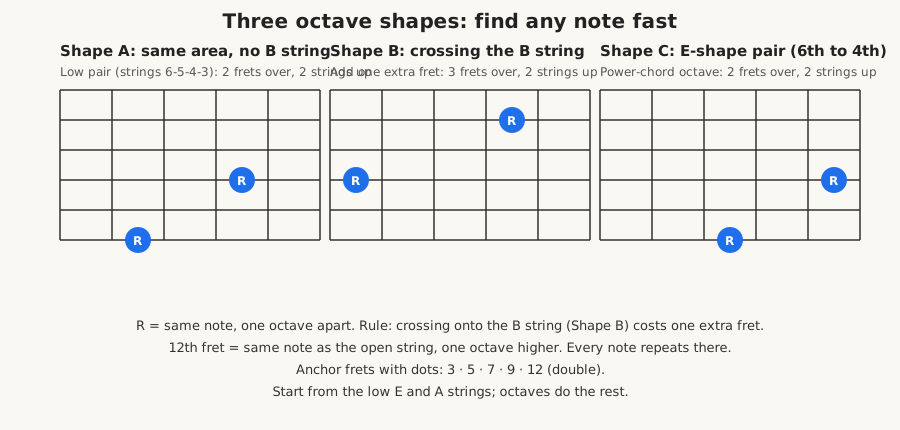
- Shape A (low pairs): two strings up, two frets up. Example: 6th string, 5th fret (A) → 4th string, 7th fret (A). Works between any adjacent pair except pairs involving the B string.
- Shape B (crossing the B string): two strings up, three frets up. Example: 4th string, 7th fret (A) → 2nd string, 10th fret (A). The extra fret compensates for the tuning kink described below.
- Shape C (power-chord octave): the familiar “two frets up, two strings up” from power chords is the same idea — index finger on the root, ring finger two frets higher on the string two rows up. Example: 6th string, 3rd fret (G) → 4th string, 5th fret (G).
Pick any note you know on string 6 or 5, apply the shape, and you have two more positions of the same note for free.
3. The E–A–D–G interval pattern (and the B-string kink)
Standard tuning stacks perfect fourths between most neighbouring strings: E→A, A→D, D→G are each five semitones. That means the note at any fret on one string appears five frets lower on the next string up — or, going the other way, the same fret on the next string up is five semitones higher.
The single exception is G→B, a major third (four semitones), which shifts everything on the B and high-E strings one fret flat relative to the pattern. This is why Shape B needs three frets instead of two, and why scale and chord shapes “bend” when they cross the B string. It is not a flaw in your understanding — it is a deliberate tuning compromise that makes open chords playable with four fingers.
4. The 12th-fret mirror
Fret 12 sounds the open-string note one octave higher, and every fret above 12 repeats frets 0–12. So the 14th fret of the G string is A (same as fret 2, one octave up), the 15th is A♯, and so on. If you can name frets 0–12, you can name the dusty end of the neck too.
The 2-week memorisation plan (10 minutes a day)
Three exercises, ten minutes daily. All you need is your guitar, the diagram above or the printable guitar fretboard notes pdf, and a metronome for the final exercise.
Exercise 1 — One string, natural notes only (4 minutes)
Pick one string per day (day 1: low E, day 2: A, and so on, then cycle). Play up the string saying each natural note aloud — E, F, G, A, B, C, D — skipping the sharps for now. Go up to the 12th fret and back down. Saying the names out loud matters: silent playing lets your eyes do the work and your memory stays empty. By the end of week 1 you should be able to name any natural note on strings 6, 5, and 4 without counting.
Exercise 2 — Octave jumps (3 minutes)
Fret any note on the low E or A string (start with the dotted frets: 3, 5, 7). Name it, then find the same note with the matching octave shape and play both. Move the starting note up one fret and repeat. This turns two memorised strings into six known positions per note, and it is the single fastest multiplier in this plan. Week 2 adds Shape B across the B string once Shape A feels automatic.
Exercise 3 — Random-note recall (3 minutes)
From day 4 onward, replace Exercise 1’s second half with this: have a friend (or a dice roll: string = 1–6, fret = 0–12) pick a random position, and name the note within three seconds. Check yourself against the tables above. Keep a tally of hits and misses — most players find the G and B strings lag behind, which tells you where to aim Exercise 1 the next day. In week 2, set the metronome to 60 bpm and name one note per click.
What “done” looks like: naming any natural note anywhere on the neck within two seconds, and any sharp within four. That is enough to read chord roots, follow the CAGED system guide, and start the pentatonic scale boxes without getting lost. Total fluency takes longer, but this baseline changes how every future lesson feels.
Acoustic vs electric: same notes, different feel
Whether you are studying acoustic guitar notes on a dreadnought or electric guitar notes on a solid-body, every note name, fret position, and frequency in this guide applies identically in standard tuning — a 5th-fret A on the low E string is 110 Hz on both. What changes is how you experience the neck while learning it.
Acoustic strings are heavier and sit higher off the fretboard, so pressing cleanly near the 12th fret takes more hand strength; beginners often learn the low positions first and meet the upper frets later. Electrics typically have lighter strings, lower action, and cutaways that expose the high frets, making octave-shape practice across the whole neck physically easier. Amplification also sustains notes longer, which helps when you are checking a fretted pitch against the Guitar Tuner.
None of this changes what to memorise — it only changes the order that feels comfortable. Learn the note names on whichever guitar you own; they transfer without modification.
Bass guitar notes: the same neck, one octave down
A standard 4-string bass is tuned E–A–D–G — the same note names as the guitar’s four lowest strings, each sounding one octave lower:
| Bass string | Note | Sounds at | Same name on guitar |
|---|---|---|---|
| 4 (thickest) | E | E1, 41.20 Hz | 6th string E2 |
| 3 | A | A1, 55.00 Hz | 5th string A2 |
| 2 | D | D2, 73.42 Hz | 4th string D3 |
| 1 (thinnest) | G | G2, 98.00 Hz | 3rd string G3 |
Because the names and fret layout match, every per-string table above works for bass if you read it as strings 4–1 and remember the pitch sits an octave lower. The octave shapes transfer too, with one simplification: basses tune in fourths all the way across (no B-string kink), so Shape A works between every pair of neighbouring strings. Bassists who also play guitar get the memorisation almost free — and guitarists picking up bass already know where every note is. For tuning references, see the bass tuning chart and the Bass Tuner. For dedicated 4-string and 5-string neck charts, open frequencies, and practice routines, explore our bass fretboard notes guide.
Ukulele notes (mini-guide): G–C–E–A
A standard soprano, concert, or tenor ukulele is tuned G–C–E–A (soprano G is G4, 392 Hz — the famous “re-entrant” tuning where the G string sounds higher than the C string). The fret logic is identical — one semitone per fret, twelve notes repeating — but the starting points differ:
| Uke string | Open note | 3rd fret | 5th fret | 7th fret | 12th fret |
|---|---|---|---|---|---|
| 4 | G | A♯ | C | D | G |
| 3 | C | D♯ | F | G | C |
| 2 | E | G | A | B | E |
| 1 | A | C | D | E | A |
Guitarists will recognise the shapes: ukulele chord forms overlap with the top four guitar strings moved around, and the anchor-fret habit (dots at 3, 5, 7, 10 on most ukes) works the same way. If you play both instruments, learn the ukulele’s open-string landmarks first — the chromatic counting you practised on guitar applies unchanged. You can apply this same method on ukulele using our complete ukulele fretboard notes guide. See the Instrument Tuner for frequencies and tuning procedure across instruments.
Practise with the Virtual Guitar Lab
Reading note names is the start; hearing them under your fingers is the point. Open the Virtual Guitar Lab and try this sequence:
- Find the dots. Click or fret the 3rd, 5th, 7th, 9th, and 12th frets on the low-E string and say each note (G, A, B, C♯, E) before you look at the tables.
- Play the octave shapes. Fret a root on the 6th string, then the Shape A position two strings up and two frets over. Listen for the “same note, higher” quality — octaves have a distinctive hollow match that trains your ear as well as your eyes.
- Run Exercise 2 digitally. Any spare five minutes away from your guitar still counts: pick a note, predict its octave position, then check it in the Lab.
- Connect to chords and scales. Once roots feel solid, the guitar chord chart shows where those notes become chord roots, the beginner chords guide puts them into your first progressions, and the CAGED system guide turns them into a full neck map.
Keep our Download the printable PDF sheet of printable guitar notes on neck beside you for the first two weeks — checking the chart is practising, not cheating, as long as you guess before you look.
Related tools
- Virtual Guitar Lab — see and hear every fret in the browser while you memorise the neck.
- Bass Fretboard Notes — complete charts and octave maps for 4-string and 5-string bass.
- Ukulele Fretboard Notes — complete charts and octave maps for standard GCEA and baritone ukulele.
- Guitar Tuner — tune to the exact open-string frequencies in this guide before you practise.
- Metronome — keep time during the random-note recall drill in week 2.
- Guitar Tuning Chart — frequencies and MIDI numbers for standard and alternate tunings.
- CAGED System for Guitar — the next step: five moveable shapes rooted on the notes you just learned.
- Guitar Chord Chart — where fretboard notes become chord roots and barre positions.