
Ukulele Fretboard Notes: Charts for GCEA & Baritone
Complete ukulele fretboard notes charts for standard GCEA and baritone DGBE. Full 0–12 neck maps, frequencies, octave shapes, and practice methods.
A standard soprano, concert, or tenor ukulele is tuned G–C–E–A (strings 4 to 1). Standard ukuleles use re-entrant high-G tuning: string 4 (G4, 392.00 Hz) is tuned higher in pitch than string 3 (C4, 261.63 Hz), creating the ukulele’s characteristic bright chime. Larger baritone ukuleles use linear D–G–B–E tuning, matching the top four strings of a standard guitar.
Every fret raises pitch by one semitone. Twelve semitones complete an octave, meaning fret 12 reproduces the open string note one octave higher. Below are 0–12 neck maps, chromatic tables for GCEA and baritone, open frequencies, and octave shortcuts for rapid memorisation.
Full fretboard diagram: frets 0–12 (standard GCEA)
The diagram below maps every note on a standard-tuned ukulele across the first twelve frets. Blue dots mark natural notes (A, B, C, D, E, F, G), and dark slate dots mark sharps (♯). String 1 (A4) sits at the top; String 4 (G4) sits at the bottom.
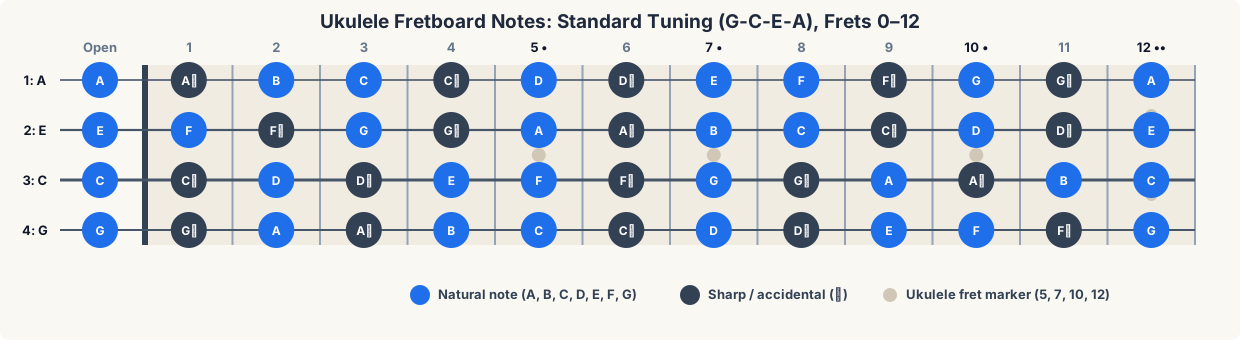
Three structural features help you navigate this neck:
- Natural semitones: B–C and E–F have no sharps between them and sit on adjacent frets (open string 2 is E; fret 1 is immediately F).
- Ukulele fret markers: Standard ukuleles place fretboard markers at frets 5, 7, 10, and 12 (unlike guitars, which mark fret 9). Fret 10 is your anchor, marking G on string 1, D on string 2, A♯ on string 3, and F on string 4.
- The 12th-fret mirror: Fret 12 duplicates open strings (G–C–E–A) one octave higher. Frets beyond 12 mirror frets 1 to 12.
Standard GCEA fretboard notes table (frets 0–12)
The reference table below maps every chromatic step across strings 1 to 4. Ukulele players conventionally name accidentals using sharps.
| String | 0 | 1 | 2 | 3 | 4 | 5 | 6 | 7 | 8 | 9 | 10 | 11 | 12 |
|---|---|---|---|---|---|---|---|---|---|---|---|---|---|
| 1 (A4) | A | A♯ | B | C | C♯ | D | D♯ | E | F | F♯ | G | G♯ | A |
| 2 (E4) | E | F | F♯ | G | G♯ | A | A♯ | B | C | C♯ | D | D♯ | E |
| 3 (C4) | C | C♯ | D | D♯ | E | F | F♯ | G | G♯ | A | A♯ | B | C |
| 4 (G4) | G | G♯ | A | A♯ | B | C | C♯ | D | D♯ | E | F | F♯ | G |
Landmarks: String 1 frets 3 (C), 5 (D), 7 (E), 10 (G); string 2 frets 1 (F), 3 (G), 5 (A); string 3 frets 2 (D), 4 (E), 7 (G); string 4 frets 2 (A), 5 (C), 7 (D).
Baritone ukulele fretboard notes table (DGBE, frets 0–12)
Baritone ukuleles tune down to D3, matching guitar strings 4 through 1:
| String | 0 | 1 | 2 | 3 | 4 | 5 | 6 | 7 | 8 | 9 | 10 | 11 | 12 |
|---|---|---|---|---|---|---|---|---|---|---|---|---|---|
| 1 (E4) | E | F | F♯ | G | G♯ | A | A♯ | B | C | C♯ | D | D♯ | E |
| 2 (B3) | B | C | C♯ | D | D♯ | E | F | F♯ | G | G♯ | A | A♯ | B |
| 3 (G3) | G | G♯ | A | A♯ | B | C | C♯ | D | D♯ | E | F | F♯ | G |
| 4 (D3) | D | D♯ | E | F | F♯ | G | G♯ | A | A♯ | B | C | C♯ | D |
Open-string frequencies and tuning notes (A4 = 440 Hz)
Concert pitch fixes A4 at 440.00 Hz. All other pitches follow from twelve-tone equal temperament. Verify open strings with our Ukulele Tuner before practising.
| Instrument / String | Note | Pitch | Frequency | MIDI | Tuning role |
|---|---|---|---|---|---|
| Ukulele 4 | G | G4 | 392.00 Hz | 67 | Re-entrant high-G |
| Ukulele 3 | C | C4 | 261.63 Hz | 60 | Middle C (lowest pitch) |
| Ukulele 2 | E | E4 | 329.63 Hz | 64 | Major third above C |
| Ukulele 1 | A | A4 | 440.00 Hz | 69 | Concert pitch reference |
| Baritone 4 | D | D3 | 146.83 Hz | 50 | Guitar 4th string (D3) |
| Baritone 3 | G | G3 | 196.00 Hz | 55 | Guitar 3rd string (G3) |
| Baritone 2 | B | B3 | 246.94 Hz | 59 | Guitar 2nd string (B3) |
| Baritone 1 | E | E4 | 329.63 Hz | 64 | Guitar 1st string (E4) |
Low-G option: Replacing string 4 with a wound string tunes it to G3 (196.00 Hz, MIDI 55). Fret positions stay identical, but the pitch drops one octave for linear range. For alternate tunings, see our ukulele tuning chart and how to tune a ukulele.
Memorisation shortcuts: unisons and octave shapes
Avoid brute-force memorisation. Use unisons and octave jumps to derive any note in seconds:
1. Re-entrant unisons
Re-entrant tuning creates unisons across different strings:
- High-G unison: Open string 4 (G4) sounds identical to string 3, fret 7 (G4), and string 2, fret 3 (G4).
- A4 unison: Open string 1 (A4) sounds identical to string 4, fret 2 (A4), and string 2, fret 5 (A4).
- E4 unison: Open string 2 (E4) sounds identical to string 3, fret 4 (E4).
Pluck these pairs together: if they waver, adjust your tuning with the Ukulele Tuner.
2. Across-string octave shapes
To locate the same note an octave higher across strings:
- String 3 to string 1: Jump up two strings and up 3 frets. Open string 3 is C4; string 1 at fret 3 is C5. Fret 2 on string 3 (D4) jumps to fret 5 on string 1 (D5).
- String 4 (low-G) to string 2: Jump up two strings and up 3 frets. Open string 4 in low-G (G3) jumps to string 2, fret 3 (G4).
The baritone and guitar connection
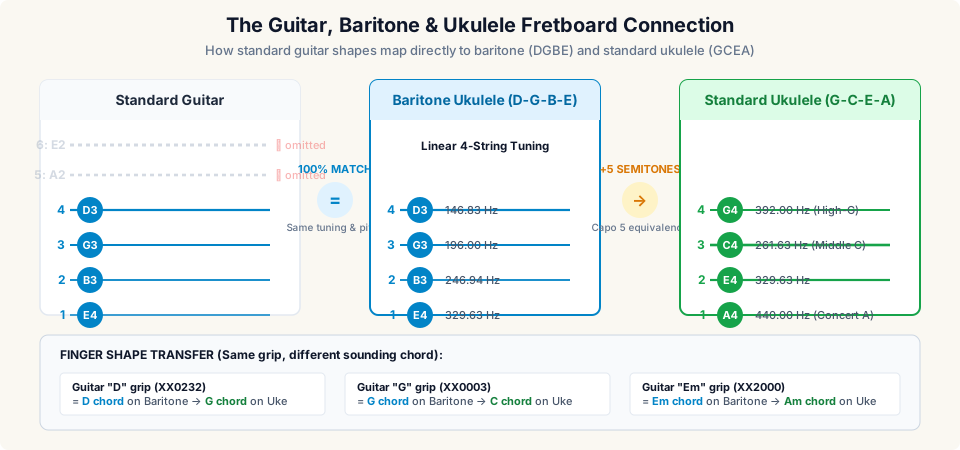
If you play guitar, you already know the ukulele fretboard layout:
-
Top four strings DGBE = Guitar minus the two bass strings: Remove guitar strings 6 and 5 (low E and A), and the remaining strings are D–G–B–E. Baritone ukulele strings 4 through 1 match guitar strings 4, 3, 2, and 1 note-for-note. If you know our guitar fretboard notes, baritone uke requires no translation.
-
Standard GCEA = Capo on fret 5: Standard ukulele tuning shares the interval relationships of DGBE, transposed up five semitones (a perfect fourth):
- D + 5 semitones = G
- G + 5 semitones = C
- B + 5 semitones = E
- E + 5 semitones = A
Standard ukulele is equivalent to the top four guitar strings with a capo at fret 5. Familiar shapes transpose up a fourth: guitar “D” becomes G, guitar “G” becomes C, and guitar “Em” becomes Am.
Daily practice routine
Spend ten minutes daily for two weeks:
- Natural notes (3 min): Pick one string daily. Play frets 0 to 12, naming each natural note aloud: C, D, E, F, G, A, B, C.
- Unisons & octaves (3 min): Fret a note on string 3 (fret 2, D). Locate its octave on string 1 (fret 5, D). Play both.
- Random recall (4 min): Set our Metronome to 60 bpm. Every two clicks, find a random note called by a dice roll.
Test your fretboard knowledge in the browser with the Virtual Ukulele, and verify tuning before each session with the Ukulele Tuner.
Related tools
- Ukulele Tuner — tune open strings to GCEA or baritone DGBE with mic detection.
- Virtual Ukulele — play notes, explore chords, and test fret positions interactively in your browser.
- Guitar Fretboard Notes — complete 0–12 neck charts and octave shapes for 6-string guitar.
- Metronome — practise timed fretboard recall drills at steady tempos.
- Instrument Tuner — chromatic tuner for ukulele, guitar, bass, and violin.
- Guitar Tuner — precision pitch detection for standard and alternate guitar tunings.
- Virtual Guitar Lab — interactive fretboard and chord explorer for acoustic and electric guitar.