
The CAGED System for Guitar: Five Shapes That Map the Whole Neck
Learn the CAGED system for guitar: the five moveable chord shapes, how they connect up the neck, and a 5-minute routine to practise them.
The CAGED system is a way of seeing the guitar neck as five repeating chord shapes — C, A, G, E and D — that connect end to end and repeat every 12 frets. If you already know those five open chords, you already know the raw material; CAGED just shows you how each one slides up the neck to play any major chord anywhere.
This guide walks through each shape with a diagram, shows where the root notes sit, explains how the shapes link together, and ends with a short daily routine.
Printable PDF: Download the CAGED system cheat sheet — all five shapes, root positions, and connection order on a single print-friendly page.
The five open shapes, and why they are moveable
Play the open chords C, A, G, E and D in first position and look at what your fretting hand is doing. Each one is a distinct grip that rings out a major chord using some open strings. Now imagine sliding any of those grips up the neck and replacing the open strings with a barred first finger. The grip still produces a major chord — just a higher one. That is the whole trick: every open shape is also a moveable barre-chord template.
The order matters too. Played for a single chord up the neck, the shapes always appear in the sequence C–A–G–E–D, then repeat. That is where the name comes from.
| Shape | Open chord frets (low E to high E) | What moves it |
|---|---|---|
| C | x–3–2–0–1–0 | Barred C shape (used sparingly, wide stretch) |
| A | x–0–2–2–2–0 | 1st-finger bar plus the three-finger triangle |
| G | 3–2–0–0–0–3 | Rarely barred whole — used in fragments |
| E | 0–2–2–1–0–0 | The standard barre chord (1st finger = nut) |
| D | x–x–0–2–3–2 | Usually played on the top four strings only |
Two of these do most of the heavy lifting in real playing: the E shape (the everyday barre chord) and the A shape. The C, G and D shapes are more often used as fragments — two or three strings at a time for triads and arpeggios — because the full grips demand stretches most hands cannot make cleanly.
The C shape
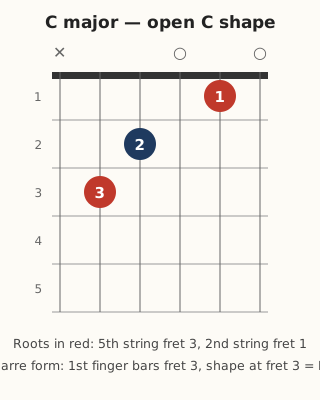
The open C chord (x–3–2–0–1–0) uses fingers 1, 2 and 3 across three strings, with the 3rd and 1st strings ringing open. Its two root notes — the two C notes — sit on the 5th string at fret 3 and the 2nd string at fret 1. Learn those two dots first, because they are what you will aim for when you move the shape: wherever those two relative positions land on C notes, the grip sounds a C chord.
As a moveable form, the full C shape is a stretch. Bar fret 3 with your first finger and build the C grip above it and you get a D chord — but spanning four frets with a bar underneath is uncomfortable for most players, so the practical use is smaller: the three-string fragment on the top strings works nicely as a triad anywhere on the neck.
Common mistake: letting the open G string (3rd string) get muted by a lazy second finger. Arch the finger so the tip lands squarely on the 4th string and the G rings through — the chord sounds hollow without it.
The A shape
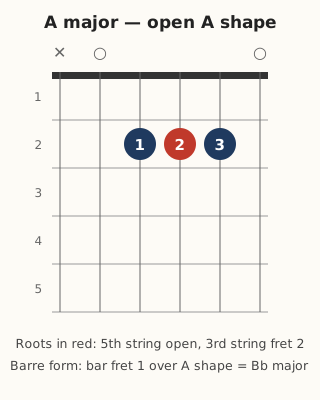
The open A chord (x–0–2–2–2–0) stacks three fingers in a row on the 4th, 3rd and 2nd strings at fret 2, with the 5th and 1st strings open. The roots — the two A notes — are the open 5th string and the 3rd string at fret 2.
The A shape is the second most useful barre in the system. Bar across fret 1 with your first finger, squeeze the three-finger triangle into fret 2 above it, and you are playing Bb major. Slide the whole thing to fret 3 and it is C major; to fret 5, D major. Many players swap the three-finger squeeze for a single third-finger mini-bar across the three strings, which frees a finger for embellishments — both fingerings are standard, so use whichever rings cleaner for you.
Common mistake: the open 1st string getting choked by the third finger leaning over it. Roll the third finger slightly onto its tip and strum slowly, listening for all five strings before speeding up.
The G shape
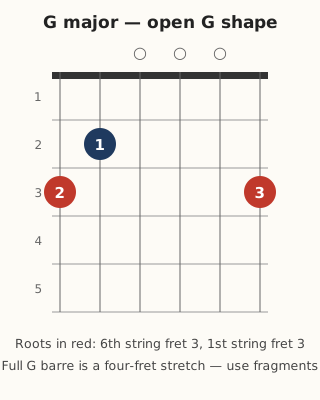
The open G chord (3–2–0–0–0–3) is the widest of the five grips, reaching from fret 2 to fret 3 across all six strings. Its three roots — the three G notes — are the 6th string at fret 3, the open 3rd string, and the 1st string at fret 3. The two fretted roots on the outer strings are the same note two octaves apart, which is why the shape sounds so full when all six strings ring.
Be honest with yourself here: nobody plays a full six-string G-shape barre in real music. Moved up the neck, the shape spans four frets including the bar, which is beyond most hands. Treat the G shape as a map of where the roots and chord tones are, and play two- or three-string pieces of it.
Common mistake: trying to compress the whole G shape into a full barre and concluding CAGED “doesn’t work”. It works — the mistake is expecting every shape to be a six-string grip. Fragments count.
The E shape
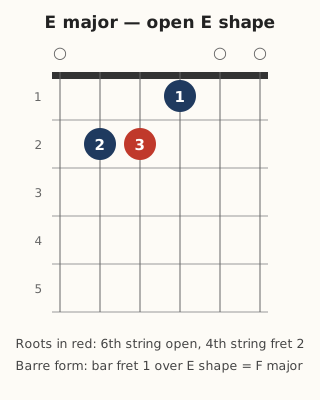
The open E chord (0–2–2–1–0–0) is the shape most guitarists meet first, and it becomes the most important barre chord on the instrument. The roots — the E notes — are the open 6th string, the 4th string at fret 2, and the open 1st string. That low-E root is the one that names every barre chord you will ever play with this shape: bar at fret 1 and the root moves to F, so the grip is F major; bar at fret 3 and it is G major; bar at fret 5, A major.
If you only learn one CAGED barre, make it this one. The first finger acts as a moveable nut, and fingers 2, 3 and 4 keep exactly the relationship they had in the open chord. Practise sliding it chromatically — F, F#, G, G# — naming each chord from the root on the 6th string as you go.
Common mistake: a buzzing bar from pressing with the flat of the finger instead of the bony edge. Roll the first finger slightly toward the headstock so its hard outer edge does the clamping, and keep it close to the fret wire without sitting on top of it.
The D shape
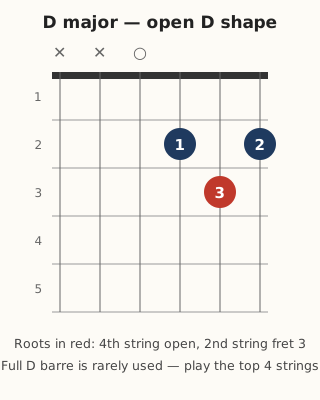
The open D chord (x–x–0–2–3–2) lives on the top four strings, with the bass strings muted or skipped. Its roots — the two D notes — are the open 4th string and the 2nd string at fret 3. Like the A shape, it contains a neat octave pair: the same note ringing on two strings at once, which gives the grip its bright, focused sound.
As a moveable form, the D shape is handled the same way as the G: learn where it is, then play pieces of it. The full four-string grip does slide — move it up two frets with the 4th string fretted instead of open and you have an E chord — but the classic use is the three-string triangle on the top strings. Mute the bass strings deliberately with the edge of your thumb or a lightly resting finger rather than hoping the pick misses them.
Common mistake: squeezing the full D shape into a six-string barre and straining the wrist. The shape was born on four strings; keep it there and let the E and A shapes handle the bass end.
How the shapes connect: one chord across the whole neck
Here is the payoff. Take a single chord — C major — and play it in every shape from the open position to fret 12. The shapes appear in C-A-G-E-D order, each one starting roughly where the last one ended, sharing at least one root note with its neighbour. At fret 12 everything repeats an octave higher.
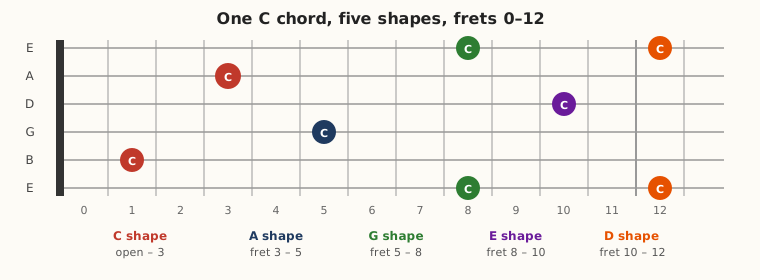
The shared roots are what glue the chain together. The table below lists, for a C chord, where each shape sits and which root note it hands off to the next shape. Work through it slowly with the Virtual Guitar Lab open: play each voicing, then find the shared root before moving on.
| Shape | C chord position | Root notes you can see | Hands off to |
|---|---|---|---|
| C | open – fret 3 | 5th string fret 3, 2nd string fret 1 | A shape (shares the 5th-string root) |
| A | fret 3 – 5 | 5th string fret 3, 3rd string fret 5 | G shape (shares the 3rd-string root) |
| G | fret 5 – 8 | 6th string fret 8, 3rd string fret 5 | E shape (shares the 6th-string root) |
| E | fret 8 – 10 | 6th string fret 8, 4th string fret 10 | D shape (shares the 4th-string root) |
| D | fret 10 – 12 | 4th string fret 10, octave at fret 12 | C shape again, one octave up |
Two things worth noticing. First, the 5th-string root at fret 3 appears in both the C and A rows — that overlap is the joint between the shapes, and every joint in the chain works the same way. Second, the whole pattern is chord-independent: for G major the same chain starts at the G shape in open position and runs G–E–D–C–A.
CAGED for scales, arpeggios and the pentatonic connection
Chords are only the beginning. Each CAGED shape contains a matching arpeggio (root, third and fifth traced through the grip) and a matching scale pattern draped around it. When improvisers talk about “playing the changes”, they usually mean seeing the current chord’s CAGED shape and choosing melody notes from inside it.
The pentatonic boxes connect directly. The five minor pentatonic boxes taught in our pentatonic scale guide each sit inside one CAGED shape, sharing the same root notes. Learn a box and the chord shape that surrounds it together, and rhythm and lead stop being separate subjects.
A practical order: chord shape first, then its arpeggio (three notes, easy win), then the pentatonic box around it, then the full scale last. Each layer reuses the root-note landmarks from the one before, so nothing you learn goes to waste. To see how CAGED anchors the full major scale, natural minor, and modal patterns across all five neck positions, explore our comprehensive guitar scales guide.
A 5-minute daily practice routine
Short and regular beats long and occasional. Set a timer and do all five steps without stopping:
- Name the roots (1 minute). Pick a chord — start with G. Find its root on the 6th and 5th strings, then play the matching E-shape and A-shape barres there. Say the fret numbers out loud.
- Walk the chain (1 minute). Play the chord through all five shapes up the neck and back down, strumming each once. Slow is fine; continuity matters more than speed.
- One shape, one arpeggio (1 minute). Take whichever shape felt weakest and pluck its root, third and fifth one string at a time, up and down.
- Fragment improv (1 minute). Loop a two-chord change in the Lab — C to G, say — and play only two-string fragments from the nearest shapes. Listen more than you move.
- Stretch shape of the week (1 minute). Spend the whole minute on the G or D fragment you avoid. Play it cleanly three times, then move it up one fret and back.
Rotate the starting chord daily through C, A, G, E and D so every shape gets a turn as the home base. After a fortnight, test yourself: name a random chord and fret, and see how fast you can land the nearest shape.
Honest limits: what CAGED does not do
CAGED is a visualisation framework, not a playing method, and it has genuine blind spots worth knowing before you invest months in it.
Three-notes-per-string players often skip it. Shredders and legato players tend to organise the neck into seven three-note-per-string patterns, which suit fast position shifts and consistent picking mechanics better than CAGED’s irregular box sizes. Neither system is “correct” — they optimise for different things, and many advanced players end up blending both.
It teaches major-chord thinking first. The classic presentation is all major shapes, and minor, seventh and extended harmony can feel bolted on afterwards. If you mostly play minor-key music, learn the minor arpeggio inside each shape early.
It does not explain voice leading. Knowing five places to play C major does not tell you which one connects smoothly to the F that follows. That is a separate skill — following individual voices between chords — and it is where the system ends and musicianship begins.
The G and D barres are genuinely awkward. Any teacher who presents all five shapes as equal six-string grips is oversimplifying. The system is still worth learning for the map it gives you; just hold it lightly and steal fragments freely.
Cheat sheet and next steps
Print the map and stick it where you practise. Download the printable PDF with all five shapes, their root notes and the connection order on a single page.
Then keep going: our guitar chord chart collects every common open chord in one place for quick reference, and the pentatonic scale guide builds the five lead boxes directly on top of the shapes you just learned. Open the Virtual Guitar Lab, pick a chord, and walk it up the neck — slowly at first, naming every root as you go.
Related tools
- Virtual Guitar Lab — play every CAGED shape and hear each voicing up the neck.
- Guitar Scales — charts and five CAGED-linked positions for major, minor and modal scales.
- Guitar Tuner — tune up before judging a new shape’s sound.
- Pentatonic Scale Guide — the five lead boxes that sit inside these shapes.
- Guitar Chord Chart — every common open chord with diagrams.