
Guitar Scales: Charts for Major, Minor, Pentatonic & Modes
Master guitar scales: major scale formulas, 5 CAGED positions, natural minor and relative major charts, mode overviews, and a daily practice method.
The most effective order to learn guitar scales is to start with the minor pentatonic scale, progress to the major pentatonic scale, expand into the full seven-note major scale and natural minor scale, add the blues scale, and finally explore the diatonic modes. Starting with pentatonic shapes gives your hands immediate musical footing without clashing half steps, while the full major scale unlocks chord theory and fretboard geometry.
A scale is a musical roadmap showing which notes sound consonant over a chord. Instead of memorising dozens of disconnected patterns, mastering one core scale family across the neck and understanding interval formulas lets you play in all twelve keys. You can explore and hear every scale degree interactively using our Guitar Scale Finder or the Virtual Guitar Lab.
Printable PDF: Download the guitar scales chart — five CAGED scale positions, natural minor charts, and mode formulas on a print-friendly reference sheet.
What a scale is: tones, semitones, and formulas
A scale is an ordered sequence of pitches spanning an octave, defined by a specific pattern of distances between adjacent notes. In Western music, the octave contains twelve equal chromatic pitches. The distance between neighbouring pitches is a semitone (half step). Two semitones combine into a whole tone (whole step).
On the guitar fretboard, these intervals translate directly into physical spacing:
- 1 semitone (half step): a distance of 1 fret on the same string (e.g. fret 5 to fret 6).
- 1 whole tone (whole step): a distance of 2 frets on the same string (e.g. fret 5 to fret 7).
- Octave (12 semitones): the same note vibrating at double or half the frequency (e.g. open A to fret 12 on the A string).
Every scale is a formula of whole tones (W) and semitones (H) starting from a root note. Because standard guitar tuning (E-A-D-G-B-E) uses fourths between all string pairs except G to B (a major third), scale formulas can be played along a single string or organised into multi-string “box” positions across four to five frets. To build familiarity with individual string pitches, review our guide to Guitar Fretboard Notes.
The major scale formula and five CAGED positions
The major scale is the foundational yardstick of Western music theory. Every interval, chord formula, mode, and arpeggio is measured against it. Its step formula consists of seven intervals:
$$\text{Whole} - \text{Whole} - \text{Half} - \text{Whole} - \text{Whole} - \text{Whole} - \text{Half} \quad (W - W - H - W - W - W - H)$$
Numbered by scale degrees from root (1) to octave (8), the formula is written 1 - 2 - 3 - 4 - 5 - 6 - 7 - 8. In the key of C major (no sharps or flats), the notes are C - D - E - F - G - A - B. The half steps sit between degrees 3–4 (E–F) and 7–8 (B–C), generating the melodic pull and resolution central to major harmony.
Five CAGED-linked major scale positions
Guitarists map the major scale across the neck using the five chord shapes of the CAGED System (C, A, G, E, and D shapes). Each position wraps around a familiar chord grip, allowing your fingers to target chord tones effortlessly.
Do not confuse these seven-note major scale positions with pentatonic boxes. Pentatonic scales omit degrees 4 and 7; the major scale simply restores those two semitone-defining degrees. For dedicated five-box minor and major pentatonic diagrams, see our Pentatonic Scale for Guitar guide.
The five diagrams below illustrate the C major scale across the neck. Blue dots mark C roots, grey dots mark other scale degrees, and string labels run from low E at the top to high E at the bottom.
Position 1: C shape (frets 0 to 3)
Position 1 sits at the nut in open position, wrapping around the open C major grip.
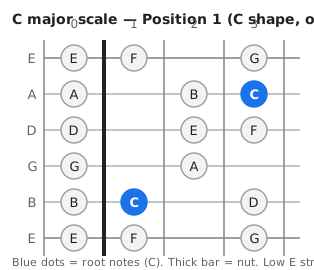
- Frets and roots: Frets 0–3 (nut marked by thick line); roots on string 5 (fret 3) and string 2 (fret 1).
Position 2: A shape (frets 2 to 6)
Position 2 centres on the barre chord derived from the open A shape.
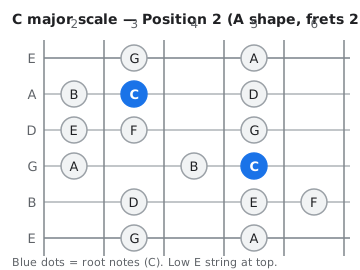
- Frets and roots: Frets 2–6; roots on string 5 (fret 3) and string 3 (fret 5).
Position 3: G shape (frets 4 to 8)
Position 3 covers the wide G-shape chord grip anchored on fret 8.
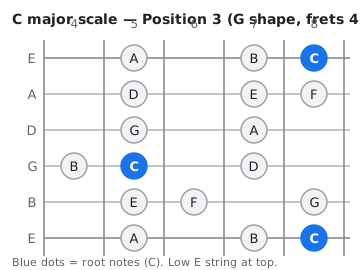
- Frets and roots: Frets 4–8; roots on string 6 (fret 8), string 3 (fret 5), and string 1 (fret 8).
Position 4: E shape (frets 7 to 11)
Position 4 wraps around the standard 6th-string root barre chord (E shape).
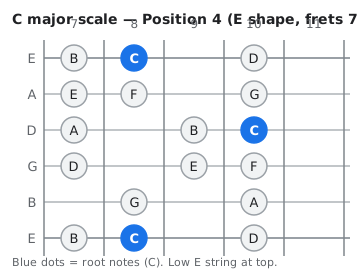
- Frets and roots: Frets 7–11; roots on string 6 (fret 8), string 4 (fret 10), and string 1 (fret 8).
Position 5: D shape (frets 9 to 13)
Position 5 connects Position 4 back toward the octave, built around the moveable D shape.
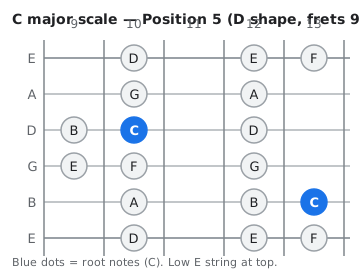
- Frets and roots: Frets 9–13; roots on string 4 (fret 10) and string 2 (fret 13).
Natural minor and relative major
Every major scale pairs with a relative natural minor scale (Aeolian mode). The relative minor shares the exact same seven pitches and key signature as its major counterpart, but starts and resolves on the 6th degree of the major scale (three semitones down from the major root).
The natural minor formula replaces the major 3rd, 6th, and 7th with minor intervals: 1 - 2 - b3 - 4 - 5 - b6 - b7 ($W - H - W - W - H - W - W$).
Because C major (C-D-E-F-G-A-B) and A natural minor (A-B-C-D-E-F-G) share identical notes, the five CAGED scale positions above also map A natural minor. Over an Am chord, you play the same shapes, but target A notes for resolution.
The table below lists common guitar keys, their relative minors, key signatures, and shared pitch collections. To see how these keys cycle by fifths, use our interactive Circle of Fifths wheel.
| Major Key | Relative Minor | Key Signature | Shared Scale Notes |
|---|---|---|---|
| C major | A minor | Natural (0 sharps/flats) | C, D, E, F, G, A, B |
| G major | E minor | 1 sharp (F#) | G, A, B, C, D, E, F# |
| D major | B minor | 2 sharps (F#, C#) | D, E, F#, G, A, B, C# |
| A major | F# minor | 3 sharps (F#, C#, G#) | A, B, C#, D, E, F#, G# |
| E major | C# minor | 4 sharps (F#, C#, G#, D#) | E, F#, G#, A, B, C#, D# |
| F major | D minor | 1 flat (Bb) | F, G, A, Bb, C, D, E |
The seven diatonic modes of the major scale
Modes are rotations of the major scale starting on different degrees. When the C major scale starts on degree 1 (C), you hear Ionian. Starting on degree 2 (D), you hear Dorian. Starting on degree 5 (G), you hear Mixolydian. Each mode has a distinct formula, characteristic note, and musical mood:
| Mode | Degree | Formula | Characteristic Note | Musical Mood & Context |
|---|---|---|---|---|
| Ionian | 1st | 1 - 2 - 3 - 4 - 5 - 6 - 7 | Natural 4, 7 | Bright, upbeat; major pop/rock anthems, folk melodies |
| Dorian | 2nd | 1 - 2 - b3 - 4 - 5 - 6 - b7 | Natural 6th | Jazzy, soulful minor warmth; Santana solos, funk jams |
| Phrygian | 3rd | 1 - b2 - b3 - 4 - 5 - b6 - b7 | Flat 2nd (b2) | Dark, Spanish, exotic; flamenco guitar, metal riffs |
| Lydian | 4th | 1 - 2 - 3 - #4 - 5 - 6 - 7 | Sharp 4th (#4) | Dreamy, mystical, floating; film scores, Satriani, Vai |
| Mixolydian | 5th | 1 - 2 - 3 - 4 - 5 - 6 - b7 | Flat 7th (b7) | Bluesy major; Southern rock (Allman Brothers), AC/DC |
| Aeolian | 6th | 1 - 2 - b3 - 4 - 5 - b6 - b7 | Flat 6th (b6) | Emotional, sad, epic; rock ballads, metal progressions |
| Locrian | 7th | 1 - b2 - b3 - 4 - b5 - b6 - b7 | Flat 5th (b5) | Unstable, harsh, unresolved; heavy metal riffs |
Which scales to learn first: a practical roadmap
To build fretboard fluency efficiently, follow this five-stage progression:
- Minor Pentatonic Scale: Begin here. With five notes per octave (1 - b3 - 4 - 5 - b7) and two notes per string, Box 1 on the 6th string root is ergonomic, memorable, and works over blues, rock, and pop progressions without clashing.
- Major Pentatonic Scale: Using the same box patterns with roots shifted to major targets (1 - 2 - 3 - 5 - 6), this scale yields a sweet, open sound essential for country, southern rock, and lyrical solos.
- The Full Major Scale (Ionian): Once five pentatonic boxes feel natural, learn the seven-note major scale across the five CAGED positions shown above. This establishes the theoretical blueprint for chords, intervals, and diatonic harmony.
- Natural Minor & Blues Scale: Reinforce relative minor keys by framing Aeolian against the major scale. Add the chromatic flattened 5th (b5) “blue note” to your minor pentatonic boxes for classic blues bends and emotional bite.
- Diatonic Modes: Start with Dorian (the premier modern minor soloing scale) and Mixolydian (the ultimate classic rock dominant scale). These two flavours cover most real-world modal soloing scenarios.
Practice method: building speed, timing, and phrasing
Structure your daily scale practice around four deliberate steps to build real musicality:
- One position per week: Focus on a single position for an entire week rather than skimming all five. Spend the first two days finding every root note in that position before adding other degrees. On day five, practice sliding into the adjacent position through shared border notes.
- Metronome discipline: Always practice with a timekeeper. Open our free Metronome and set the tempo to 60 bpm. Play one note per click (quarter notes), ensuring synchronized picking and fretting with zero tension. Progress to eighth notes and triplets with strict alternate picking (down-up-down-up).
- Melodic sequences: Real guitar solos rarely move in straight scalar lines. Break predictability by practicing musical intervals such as groups of three (1–2–3, 2–3–4…) and broken thirds (1–3, 2–4, 3–5…). Thirds force string-skips and train your ear to hear chord harmony inside the scale.
- Target chord tones: Vamp a backing chord in the Virtual Guitar Lab. Instead of running the entire scale, compose short phrases that land on strong chord tones (root, 3rd, or 5th of the active chord). Leaving breathing room and resolving to chord tones produces expressive phrasing. Check tuning with the Guitar Tuner beforehand to ensure clean intonation.
Bass guitar scales: four-string geometry and role
If you play or arrange bass guitar, standard four-string bass tuning (E - A - D - G) is identical to the lowest four strings of a six-string guitar pitched one octave lower (E1, A1, D2, G2).
Because bass tuning is uniform across all four strings (each string pair is a pure fourth / five semitones), bass scale patterns are even more consistent than guitar patterns:
- No string-shift irregularity: On guitar, scale fingering shifts up one fret when crossing from G to B due to the major-third tuning interval. On bass, no such shift occurs; scale boxes transpose across string sets with identical fingering.
- Two-octave box geometry: Because bass strings are thicker and frets are wider, bassists typically use one finger per fret in higher registers and three-fret spans (fingers 1, 2, 4) in lower positions. A standard major scale shape begins on the 2nd finger (root), moves to 4th finger (2nd), and continues up the D and G strings.
- The bassist scale duty: While guitarists use scales primarily for melodic lines, bassists use scales to outline harmonic anchors. The primary scale notes for bass lines are the root (1), perfect 5th (5), octave (8), and passing tones that connect chords smoothly in lockstep with the kick drum.
For complete four-string and five-string bass neck maps, see our Bass Fretboard Notes guide and the Bass Tuner.
Printable scale chart PDF
Keep these CAGED scale positions, mode formulas, and relative key charts on your music stand. We have assembled a two-page reference sheet featuring C major in five positions, natural A minor charts, and a degree-to-semitone conversion legend.
Related tools
- Guitar Scale Finder — interactive scale finder with full neck, 5 box positions, 3NPS patterns, and degree labels.
- Virtual Guitar Lab — test and hear every scale position and degree on an interactive neck.
- Pentatonic Scale for Guitar — five essential minor and major pentatonic boxes explained in depth.
- The CAGED System for Guitar — how moveable chord grips map the full fretboard.
- Guitar Fretboard Notes — complete note charts and memorisation strategies for standard tuning.
- Circle of Fifths — interactive wheel for relative major/minor keys, accidentals, and chord families.
- Metronome — build clean alternate picking and rhythmic precision.
- Bass Fretboard Notes — four-string and five-string bass neck charts and note frequencies.
- Guitar Tuner — tune your guitar before scale practice for pitch accuracy.