
Bass Fretboard Notes: Charts for 4-String & 5-String Bass
Complete bass fretboard notes charts for 4-string and 5-string bass. Full 0–12 neck maps, frequencies, octave shapes, and practice methods.
A standard 4-string bass guitar is tuned E–A–D–G from lowest to highest string, sounding an octave below guitar strings 6 to 3. A 5-string bass adds a low B string (B–E–A–D–G), reaching sub-bass pitch B0 at 30.87 Hz.
Because adjacent bass strings tune in perfect fourths (five semitones), the fretboard forms a uniform grid without guitar’s B-string irregularity. Every fret raises pitch by one semitone, repeating at the 12th fret. Below are neck diagrams, note tables, frequencies, and memorisation shortcuts.
4-string bass fretboard map (frets 0–12)
The 4-string diagram maps frets 0 to 12 in standard EADG tuning. Blue markers indicate natural notes (A, B, C, D, E, F, G); dark markers indicate accidentals (sharps).
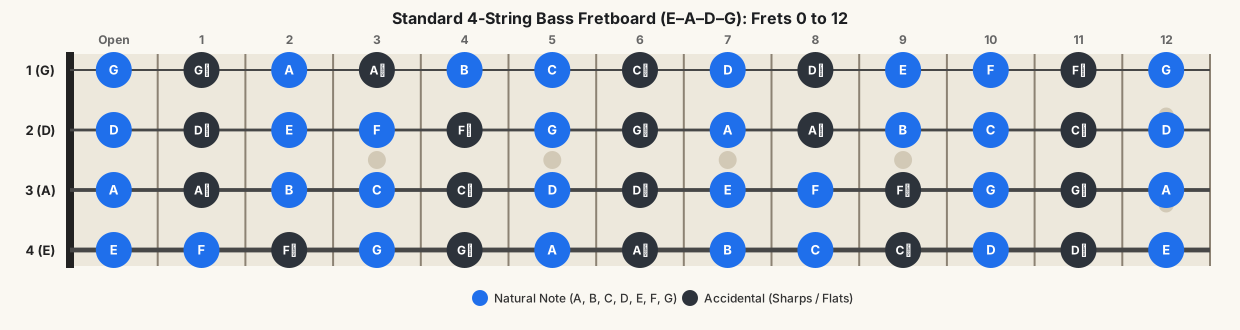
Natural landmarks B–C and E–F sit directly side-by-side with no sharp between them. Fret 12 duplicates open strings (E–A–D–G) one octave higher.
5-string bass fretboard map: the low B string
A 5-string bass adds a low B0 string, unlocking low D, C, and B without drop tunings.
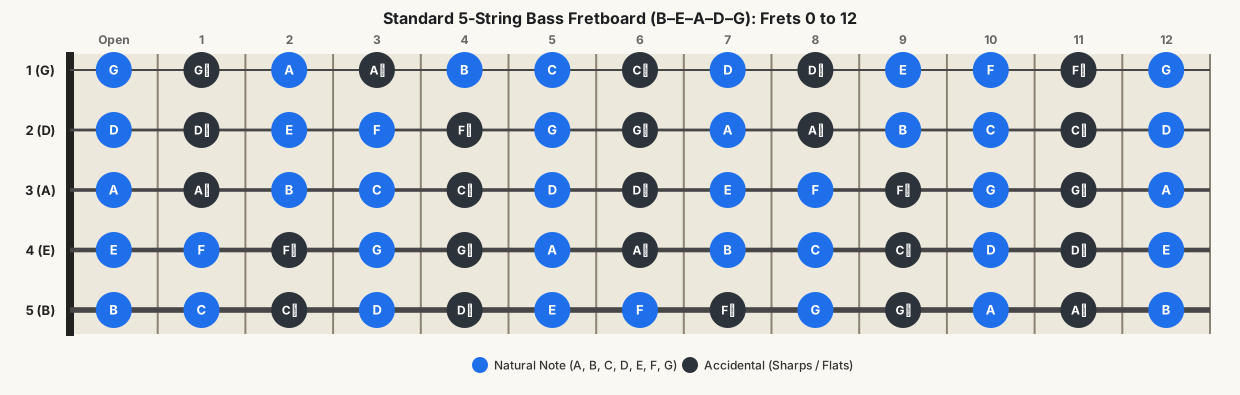
The low B string also improves economy: low E sits at fret 5 of string 5, letting you play low passages in 5th position without shifting toward the nut.
Complete bass fretboard notes table (frets 0–12)
The reference table below maps every chromatic step across strings 1 to 5. Bassists traditionally refer to fretted accidentals using sharps (such as F♯ instead of G♭).
| String | 0 | 1 | 2 | 3 | 4 | 5 | 6 | 7 | 8 | 9 | 10 | 11 | 12 |
|---|---|---|---|---|---|---|---|---|---|---|---|---|---|
| 1 (G) | G | G♯ | A | A♯ | B | C | C♯ | D | D♯ | E | F | F♯ | G |
| 2 (D) | D | D♯ | E | F | F♯ | G | G♯ | A | A♯ | B | C | C♯ | D |
| 3 (A) | A | A♯ | B | C | C♯ | D | D♯ | E | F | F♯ | G | G♯ | A |
| 4 (E) | E | F | F♯ | G | G♯ | A | A♯ | B | C | C♯ | D | D♯ | E |
| 5 (B) | B | C | C♯ | D | D♯ | E | F | F♯ | G | G♯ | A | A♯ | B |
Key anchors: string 4 frets 3 (G), 5 (A), 7 (B); string 3 frets 3 (C), 5 (D), 7 (E); string 5 frets 1 (C), 3 (D), 5 (E). Fret 5 on string 2 sounds open string 1.
Open-string frequencies and MIDI note numbers
Concert pitches follow 12-tone equal temperament (A4 = 440 Hz, $f = 440 \times 2^{(m - 69)/12}$):
| String | Note | Pitch | Hz | MIDI | Period (ms) |
|---|---|---|---|---|---|
| 5 | B | B0 | 30.87 | 23 | 32.40 |
| 4 | E | E1 | 41.20 | 28 | 24.27 |
| 3 | A | A1 | 55.00 | 33 | 18.18 |
| 2 | D | D2 | 73.42 | 38 | 13.62 |
| 1 | G | G2 | 98.00 | 43 | 10.20 |
A B0 string takes 32.4 ms per cycle. Small cabinets cannot reproduce 30.87 Hz directly; ears track harmonics (B1 61.74 Hz, F♯2 92.60 Hz) to reconstruct the fundamental.
Memorisation shortcuts: octaves and symmetrical fourths
Because bass strings tune in pure fourths without guitar’s major-third shift, memorisation relies on three shortcuts:
1. The guitar-to-bass transfer
Bass strings 4, 3, 2, and 1 match guitar strings 6, 5, 4, and 3 note-for-note, sounding one octave lower. If fret 5 on guitar string 6 is A, fret 5 on bass string 4 is also A. For full guitar charts, check the guitar fretboard notes guide.
2. The universal octave shape
On bass, one octave pattern works across all strings without exception:
- Two strings up + two frets up = one octave higher
Examples:
- String 4, fret 3 (G) to string 2, fret 5 (G)
- String 3, fret 5 (D) to string 1, fret 7 (D)
- String 5, fret 3 (D) to string 3, fret 5 (D)
3. The 5th-fret unison rule
Fretting fret 5 on any string sounds the open string directly above:
- String 4 (E), fret 5 (A) = open string 3 (A)
- String 3 (A), fret 5 (D) = open string 2 (D)
- String 2 (D), fret 5 (G) = open string 1 (G)
- String 5 (B), fret 5 (E) = open string 4 (E)
Bass guitar chords for beginners: dyads and practical voicings
Beginners often ask whether guitar chords work on bass. In practice, dense chords below 200 Hz sound muddy due to lower interval limits (LIL): the ear cannot resolve close fundamentals in deep octaves, producing acoustic clash.
Practical bass chord voicings use open intervals and higher registers:
- Root-fifth dyads: Pairing a root on string 4 or 3 with its fifth (one string up, two frets higher) adds punch without mud.
- Tenth intervals: A root on string 4 or 3 paired with a tenth on string 1 rings clear because the tenth sits well above lower interval limits.
- Upper-neck double stops: Frets 7–12 on strings 2 and 1 sit in the cello register (150–300 Hz), where major and minor thirds ring cleanly.
For alternate tunings when doubling heavy riffs, see the bass tuning chart.
Practical fretboard training routine
Use this 10-minute daily routine to build fretboard fluency:
- Tuning check (2 minutes): Tune every string to concert pitch with the Bass Guitar Tuner.
- Anchor-fret recitation (3 minutes): Play up strings 4 and 3 using the inlay dots (frets 3, 5, 7, 9, 12), speaking each note aloud: G, A, B, C♯, E on string 4; C, D, E, F♯, A on string 3.
- Octave jumping (3 minutes): Pick three random notes on strings 4 and 5; find their octave pairs two strings up and two frets higher.
- Interactive reference (2 minutes): Cross-reference positions on our Virtual Bass Guitar or the Virtual Guitar Lab.
Related tools
- Virtual Bass Guitar — interactive 4-string and 5-string bass fretboard in your browser.
- Bass Guitar Tuner — pitch detection for bass fundamentals down to low B.
- Virtual Guitar Lab — interactive visual neck for roots, intervals, and octave shapes.
- Bass Tuning Chart — frequencies, MIDI numbers, and period times for bass tunings.
- Guitar Fretboard Notes — complete chart and memorisation plan for 6-string guitar.
- Metronome — tempo trainer for note-naming drills.
- Guitar Tuner — chromatic tuner for standard and alternate setups.