
How to Clean a Guitar Fretboard (Rosewood, Maple & Ebony)
Learn how to clean and condition a guitar fretboard safely. Step-by-step care for rosewood, ebony, and maple necks, plus oils and common mistakes to avoid.
To clean a guitar fretboard, wipe the surface with a microfibre cloth to lift sweat, skin oils, and dust. For unsealed hardwoods like rosewood and ebony, dislodge grime along fret edges with a plastic scraper and apply a dedicated conditioner once or twice a year.
Before cleaning, identify your neck’s wood and finish. Applying oil or excess water to the wrong surface can permanently damage the instrument.
1. Finished Maple vs. Unfinished Hardwoods
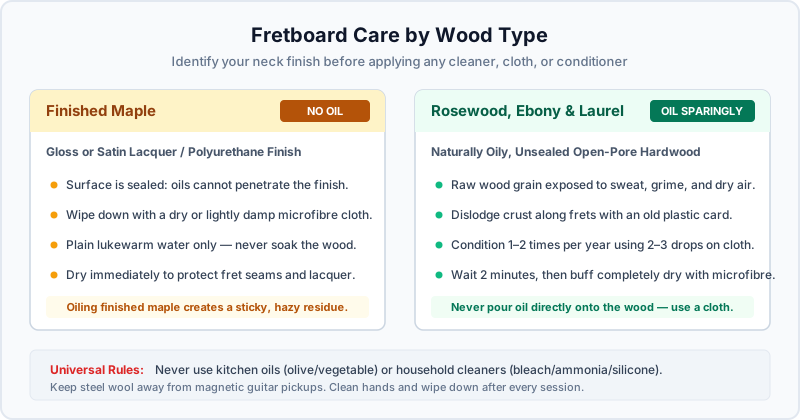
Guitar fretboards fall into two maintenance categories based on whether the timber is sealed under a factory finish or left as bare wood.
| Wood Type | Typical Finish | Primary Cleaning Method | Conditioning Rule |
|---|---|---|---|
| Finished Maple | Gloss or satin lacquer/poly | Damp microfibre cloth (water only) | Never oil. Finish blocks oil; creates sticky residue. |
| Rosewood | Unfinished (open pore) | Dry cloth; plastic card for fret edges | Condition sparingly 1–2 times per year with fretboard oil. |
| Ebony | Unfinished (dense grain) | Microfibre cloth; soft nylon brush | Condition 1–2 times per year to prevent shrinkage cracks. |
| Laurel / Pau Ferro | Unfinished | Microfibre cloth with light pressure | Treat like rosewood; condition lightly when wood turns pale. |
Finished Maple: Damp Cloth Only, No Oil
Most maple fingerboards feature a protective gloss or satin clear coat. Because this finish creates an airtight seal, fretboard oils cannot penetrate finished maple. Applying oil leaves a sticky film that collects dust. Clean with a microfibre cloth lightly dampened with plain water, then buff dry immediately.
Rosewood and Ebony: Clean and Condition Sparingly
Dark fingerboards are unsealed hardwoods. While natural oils offer baseline protection, playing deposits sweat and skin grime. In dry environments, the wood loses moisture and turns pale. These boards need periodic cleaning followed by sparing conditioning.
2. Essential Tools and Materials
A basic kit from your beginner guitar kit is all you need:
- Two microfibre cloths: One for wiping grime and one for buffing dry.
- Plastic scraper or soft brush: An old plastic card or soft toothbrush clears fret edges without scratching wood.
- Lukewarm water: Plain water on a damp cloth is safest for finished necks.
- Dedicated fretboard conditioner: Use a refined, guitar-grade mineral oil. Never use kitchen cooking oils.
- Neck rest or rolled towel: Supports the neck and protects the headstock while working.
3. Quick Clean With Strings On (Daily Routine)
Establish a 30-second habit after every playing session to keep grime from hardening:
- Wipe beneath strings: Slide a folded microfibre cloth under the strings at the first fret and draw it down to the body.
- Clean individual strings: Pinch each string inside the cloth and run it along the length to remove sweat before corrosion begins.
- Wipe the neck back: Clear moisture from the back of the neck to maintain a fast, smooth feel.
4. Deep Clean With Strings Off (Step-by-Step)
Perform a deep clean every six months during a string change.
Step 1: Support the Neck
Lay the guitar on a flat, padded surface with a neck rest or rolled towel beneath the headstock end.
Step 2: Remove Strings
Slacken and remove all six strings from the bridge and tuning posts to expose the fingerboard.
Step 3: Clear Grime Along Fret Edges
Skin oils gather where the metal fret meets the wood. Slide the corner of an old plastic card along both sides of each fret to lift crust, then wipe away debris with a slightly damp microfibre cloth along the grain.
Step 4: Condition Bare Timber Sparingly
For dry, unsealed rosewood, ebony, or laurel:
- Apply two to three drops of dedicated conditioner to a cloth—never pour directly onto the neck.
- Rub along the wood grain across all fret positions and let absorb for two minutes.
- Buff vigorously with a bone-dry cloth until no slick residue remains.
Step 5: Clean Fret Wire
Wipe along each metal fret with a dry cloth to clear tarnish and ensure smooth string bending.
5. Fretboard Care Myths and What Never to Do
Avoid these damaging practices:
- Never use cooking oils: Olive and vegetable oils do not dry; they turn rancid inside timber pores, smell bad, and soften glue joints.
- Avoid household cleaners: Ammonia, bleach, and window sprays dissolve lacquer, cloud polyurethane, and dehydrate raw wood.
- Do not over-oil: Excess oil softens wood around fret slots, loosening fret tangs and causing severe fret buzz.
- Do not soak raw wood: Water swells unsealed timber cells, warping the neck and lifting fret ends.
- Keep steel wool away from pickups: Steel wool sheds fine metal filaments that cling to magnetic pickup pole pieces, risking electrical shorts. Use non-steel synthetic abrasive pads instead.
6. Drying, Restringing, and Tuning
Allow the fingerboard to air-dry for 15 minutes before installing fresh strings.
Fit fresh strings, seating them into the nut slots and bridge saddles.
Open the Guitar Tuner in your browser. Pluck each string firmly and let it sustain so the pitch engine detects the fundamental. Always tune up into pitch from below to eliminate mechanical slack in the machine heads. Retune on a second pass after tension settles, or explore chord shapes on the Virtual Guitar Lab.
Frequently Asked Questions
How often should you clean and condition a fretboard?
Wipe the neck with a dry cloth after every session. Deep-clean during string changes every six months. Condition unfinished rosewood or ebony only once or twice a year. Never condition finished maple.
Why should you never use oil on a maple fretboard?
Maple fretboards have a clear lacquer or polyurethane seal. Oil cannot penetrate this barrier; it sits on top as a greasy film that collects dust.
Is commercial fretboard lemon oil real lemon juice?
No. Commercial guitar lemon oil is highly refined mineral oil with lemon scent. Real lemon juice contains citric acid, which corrodes fret wire and breaks down wood finishes.
Can fretboard cleaning fix fret buzz?
Cleaning clears grime for smoother bends, but cannot fix structural buzz from uneven frets or low action. If buzz persists after tuning, inspect your truss rod and saddle height.
Related tools
- Guitar Tuner — tune fresh strings accurately after cleaning and restringing.
- Virtual Guitar Lab — explore chord voicings, scales, and fretboard positions.
- Beginner Guitar Kit: What You Actually Need — essential maintenance accessories, cloths, and tools.
- How to Tune a Guitar — step-by-step tuning guide covering string order and peg mechanics.
- Metronome — precision timing tool for steady rhythm and chord transition practice.